The Malaysian PPC Landscape in 2026
Malaysia's digital advertising market has matured significantly over the past three years. Total digital ad spend surpassed RM 4.2 billion in 2025, with search advertising capturing the largest single share — roughly 38 percent — of that total. For brands across industries from financial services to property to B2B technology, Google Ads has become an indispensable part of the marketing mix.
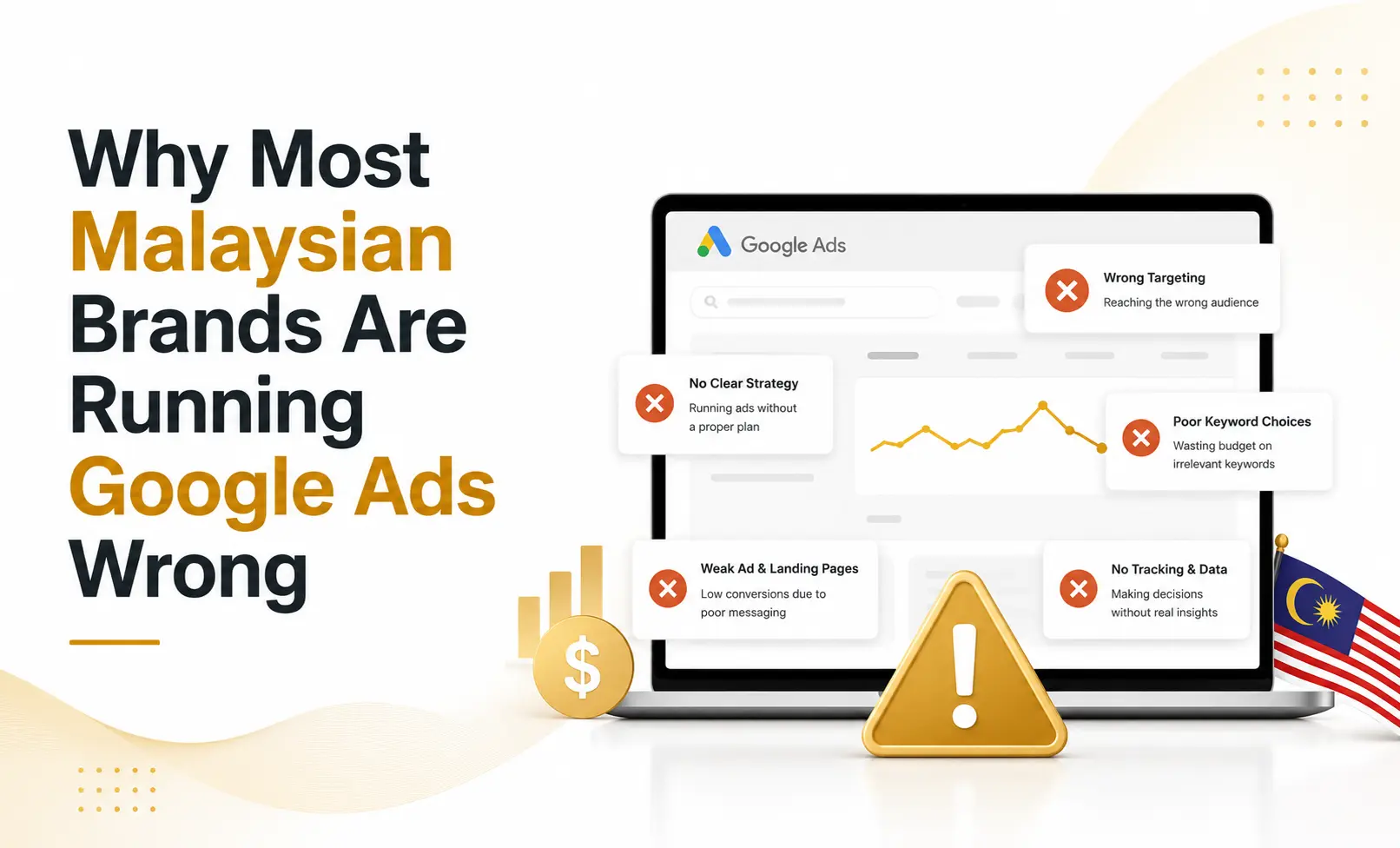
But indispensable does not mean well-managed. The majority of Malaysian brands run their Google Ads accounts either in-house with limited PPC expertise or through generalist digital agencies that lack the depth to optimise properly. The result is a market where structurally broken accounts run for months — sometimes years — without anyone identifying the core problems. Budgets are spent, reports are generated, and leadership assumes the numbers are as good as they can get.
They are not. In almost every account we audit, there are systematic errors that, once corrected, unlock material ROAS improvements — typically in the range of 30 to 60 percent — without requiring additional spend. The gains come from stopping the waste, not increasing the investment.
Below are the five mistakes we find most consistently, and the fixes that reliably move the needle.
Mistake 1: Bidding on Awareness Keywords With Purchase Intent Budgets
The most common — and most expensive — mistake in Malaysian Google Ads accounts is a fundamental mismatch between keyword intent and campaign objective. Brands allocate their conversion budgets to keywords that attract people who are curious, not people who are ready to buy.
The tell-tale sign is broad match keywords without meaningful negative keyword lists. A manufacturing company targeting "supply chain" instead of "supply chain management software Malaysia" will attract students researching for assignments, journalists writing articles, and job seekers browsing LinkedIn — not procurement managers with a budget and a deadline. Every click from those irrelevant searchers costs the same as a click from a genuine prospect.
The Search Terms Report (found under Keywords in Google Ads) makes this visible in painful detail. When we pull this report on a new audit, it is routine to see queries like "what is digital marketing" or "definition of ERP system" consuming five-figure monthly budgets on accounts that are supposed to be generating B2B leads.
The fix requires three things working together. First, shift to tighter match types — phrase match and exact match — for your core commercial keywords. Broad match has its place in mature accounts with rich negative lists, but it should be earned, not the starting point. Second, build a structured negative keyword list organised by intent category: informational queries, navigational queries, job-related queries, and competitor brand terms you do not want to show for. Third, map your keywords to intent clusters and assign budgets accordingly. Transactional keywords ("ppc agency KL", "google ads management malaysia") should receive the majority of your conversion budget. Informational keywords, if you target them at all, belong in awareness campaigns with landing pages built for that stage of the journey — not in lead generation campaigns.
Every ringgit spent on an unqualified click is a ringgit not spent on someone ready to buy. Intent mapping is not optional — it is the foundation of a profitable Google Ads account.
Mistake 2: Sending Paid Traffic to the Homepage
This mistake is so common that it has become almost invisible. A brand runs a Google Ads campaign targeting people searching for "ERP software for manufacturers Malaysia", and the ad destination is the company homepage. The homepage talks about the company's 20-year history, its full product range, its corporate values, and its latest press release. Nowhere on the page does it address the specific need the prospect was searching for.
The visitor arrives, finds no immediate confirmation that they are in the right place, and leaves within 15 seconds. The brand has paid for that visit and received nothing in return.
The conversion rate differential here is not marginal. Industry data consistently shows homepage conversion rates for paid traffic in the 1.5 to 2.5 percent range, while dedicated landing pages built for a specific ad group convert at 6 to 8 percent — sometimes higher with rigorous optimisation. In practical terms, that means three to four times more leads for the same ad spend. For a brand spending RM 30,000 per month on Google Ads, that gap translates directly into pipeline.
Malaysian B2B buyers in particular expect message continuity between the ad they clicked and the page they land on. If the ad promised a free audit of your logistics costs, the landing page must open with that exact offer, supported by specifics — not a generic "Contact Us" page with a phone number and a map. The visual language, the headline, the CTA — everything should reinforce the ad promise.
The fix is to build dedicated landing pages matched to your ad group themes. You do not need a unique page for every keyword, but you do need pages that speak directly to the intent cluster. A software company might need pages for "project management software", "ERP implementation", and "inventory management system" — each one matching the specific promise of the ads pointing to it. Our Web & CRO team typically starts here when taking over a new account, because fixing landing page relevance is the fastest way to unlock conversion rate improvement before touching a single bid.
Mistake 3: Incomplete or Broken Conversion Tracking
Google's Smart Bidding algorithms — tCPA, tROAS, Maximise Conversions — are genuinely powerful when they have good data to work with. The problem is that they are only as good as the conversion signals they receive. Give them bad data, and they will optimise brilliantly for the wrong outcome.
This is exactly what is happening in most Malaysian Google Ads accounts we review. Conversion tracking is either partially broken, tracking the wrong events, or reporting inflated conversion numbers that mask the true cost per lead.
The most common error is tracking page views — specifically "thank you page" views — as conversions, without verifying that those pages are only reachable after a genuine form submission. If the thank you page is accessible via a direct URL or a back-button refresh, every accidental visit to that page registers as a conversion. We have seen accounts where 40 percent of reported conversions were phantom events of this kind, giving the bidding algorithm a completely distorted picture of what was working.
A second common error is failing to import GA4 key events into Google Ads as conversion actions. When Google Ads and GA4 are not properly linked — with the right conversion events flowing through — Smart Bidding makes decisions without the benefit of cross-session, cross-device data that GA4 captures. The result is aggressive bidding on sessions that will not convert, and under-bidding on high-intent sessions that would.
The fix is methodical. Start by auditing every conversion action in your Google Ads account and tracing each one back to its trigger. Verify that each action fires only when the intended behaviour occurs — form submission, phone call, purchase. Set up enhanced conversions in Google Ads to improve measurement accuracy in a cookieless environment. Import your GA4 key events, and mark only true business outcomes (leads, purchases, qualified sign-ups) as primary conversion actions. Micro-events like scroll depth and video views should be secondary conversions — useful for understanding engagement, but never the signal Smart Bidding is optimising toward.
Mistake 4: Never Reviewing the Search Terms Report
Google Ads does not show your ads only for the keywords you bid on. It shows your ads for queries that Google decides are related to those keywords — and the definition of "related" has grown considerably broader since the expansion of broad match and the introduction of close variants. What you bid on and what you actually pay for are often substantially different things.
The Search Terms Report is the definitive record of what searchers actually typed before clicking your ad. It is the most important optimisation resource in the platform, and it is routinely ignored. In accounts managed by in-house teams without dedicated PPC expertise, it is common to find accounts where the search terms report has not been reviewed in three to six months. The irrelevant spend buried in that report — queries with zero commercial intent — typically represents 25 to 40 percent of total budget.
Consider a property developer in the Klang Valley bidding on "landed property" with broad match. Without a systematic negative keyword process, that campaign will serve ads to people searching for "landed property meaning", "landed property vs high rise pros cons", "landed property maintenance tips", and dozens of other informational queries that will never produce a qualified lead. Each click costs as much as a click from someone searching "landed house for sale in Subang", but the conversion probability is close to zero.
The fix is structural. Establish a weekly search terms review as a non-negotiable account maintenance task. Build a tiered negative keyword list: account-level negatives for queries that will never be relevant (competitor names you don't want to target, job-related terms, informational modifiers), campaign-level negatives for intent mismatches specific to that campaign's goal, and ad group-level negatives for conflicts between adjacent ad groups. Keep a running negative keyword log so that the same irrelevant terms are not caught and discarded repeatedly — once a term is identified as irrelevant, it should be permanently excluded. This is one of the most straightforward, highest-impact optimisations available in any account, and it costs nothing to implement.
Mistake 5: Wrong Bidding Strategy for Campaign Maturity
Google's automated bidding strategies are designed to learn from historical conversion data. The more data they have, the better they perform. The mistake many Malaysian brands make is applying advanced automated strategies — specifically Target CPA and Target ROAS — to campaigns that do not yet have enough conversion history to support them.
When a campaign is new or has fewer than 30 to 50 conversions in the past 30 days, tCPA and tROAS are flying blind. Without sufficient data, the algorithm makes volatile decisions — bidding aggressively on signals that correlate with past conversions even when those correlations are statistically meaningless at low sample sizes. The result is erratic performance: days of high conversion volume followed by extended periods of near-zero activity as the algorithm overcorrects.
The appropriate strategy for the first 30 to 60 days of a new campaign is Maximise Clicks (with a bid cap) or Manual CPC. This approach gives you control over costs while the campaign accumulates conversion data. Once the campaign has at least 50 conversions in the past 30 days — ideally 100 or more for tROAS — you can transition to automated bidding with confidence that the algorithm has the signal quality it needs.
Performance Max campaigns carry an additional risk. pMax campaigns run across all Google inventory — Search, Display, YouTube, Gmail, Discover, Maps — using assets you provide. Without high-quality assets (multiple headlines, descriptions, images, videos), Performance Max defaults to poor-quality combinations that underperform across all placements. We see accounts where Performance Max is consuming 60 percent of the monthly budget while producing a fraction of the conversions that a well-structured Search campaign on the same budget would generate.
If you are running Performance Max, audit your asset quality scores, review the search themes you have specified, and check the insights section regularly to understand which audience signals are driving performance. Performance Max can be a powerful channel when managed with rigour, but it requires active oversight — it is not a set-and-forget solution.
What a High-Performing Google Ads Account Looks Like in Malaysia
Having described five of the most damaging mistakes, it is worth outlining what the other side looks like — what a structurally sound, well-managed Google Ads account actually contains.
A high-performing account starts with a clear campaign hierarchy. At minimum, this means separate campaigns for brand terms, competitor terms, core service keywords, and generic/informational terms. Brand campaigns protect your branded search at low cost and provide unambiguous conversion data. Competitor campaigns require different landing page messaging and bidding logic. Service campaigns should be tightly organised by ad group, with each group containing closely related keywords and pointing to a matched landing page. Generic campaigns, if included, should have separate budgets and separate conversion goals — they serve a different function and should not compete with commercial campaigns for the same budget.
Conversion tracking should be verified, not assumed. Every conversion action should be audited on a scheduled basis — ideally monthly — to confirm it is firing correctly and measuring what it is supposed to measure. Enhanced conversions should be active. GA4 should be linked and key events should be imported.
The Search Terms Report should be reviewed weekly, with negatives updated as part of a documented workflow. Landing pages should be reviewed for relevance quarterly — as your services evolve, your landing pages need to evolve with them. Bidding strategies should be matched to the data maturity of each campaign, and transitions between strategies should be made deliberately, not by default.
Monthly performance reviews should compare ROAS, cost per conversion, conversion rate, and impression share against previous periods and, where data is available, against industry benchmarks. In Malaysia's enterprise and B2B markets, cost-per-lead benchmarks vary significantly by sector — financial services and property command higher CPLs than technology or professional services — so comparisons need to be sector-specific to be meaningful.
Finally, high-performing accounts are the product of ongoing work, not one-time setup. Google Ads is a competitive, dynamic platform. Competitor activity, algorithm changes, auction dynamics, and seasonality all affect performance continuously. The brands that maintain consistent results treat their accounts as living systems that require regular, expert attention — not as campaigns that run themselves once they are launched.
If you are unsure where your account stands, the starting point is an independent audit. Our PPC & Paid Media team reviews accounts with a structured framework that covers every dimension — keyword strategy, conversion tracking, landing page relevance, bidding logic, and account structure — and produces a prioritised action plan based on what will move the needle fastest for your specific budget and goals.