Why Your Landing Page Is Probably Costing You Conversions
The average landing page conversion rate across Malaysian B2B brands sits between 1.8 and 2.4 percent. The industry benchmark for a well-optimised page — one that has been audited, tested, and iterated — is 5 to 8 percent. That gap is not the result of different traffic quality, different offers, or different industries. In most cases, it is entirely the result of structural problems on the page itself: problems that are diagnosable, fixable, and do not require additional ad spend to resolve.
Consider what that gap means in practice. A brand spending RM 25,000 per month on paid search and generating 5,000 visitors to their landing pages at a 2 percent conversion rate produces 100 leads per month. At 6 percent — a realistic target for a properly optimised page — the same traffic produces 300 leads. Three hundred leads per month versus one hundred, from the same budget, to the same audience, with the same offer. The only variable is the landing page.
Most Malaysian brands invest heavily in driving traffic and almost nothing in converting it. The fix costs a fraction of the traffic budget and delivers results that compound over time rather than disappearing when the ad spend stops.
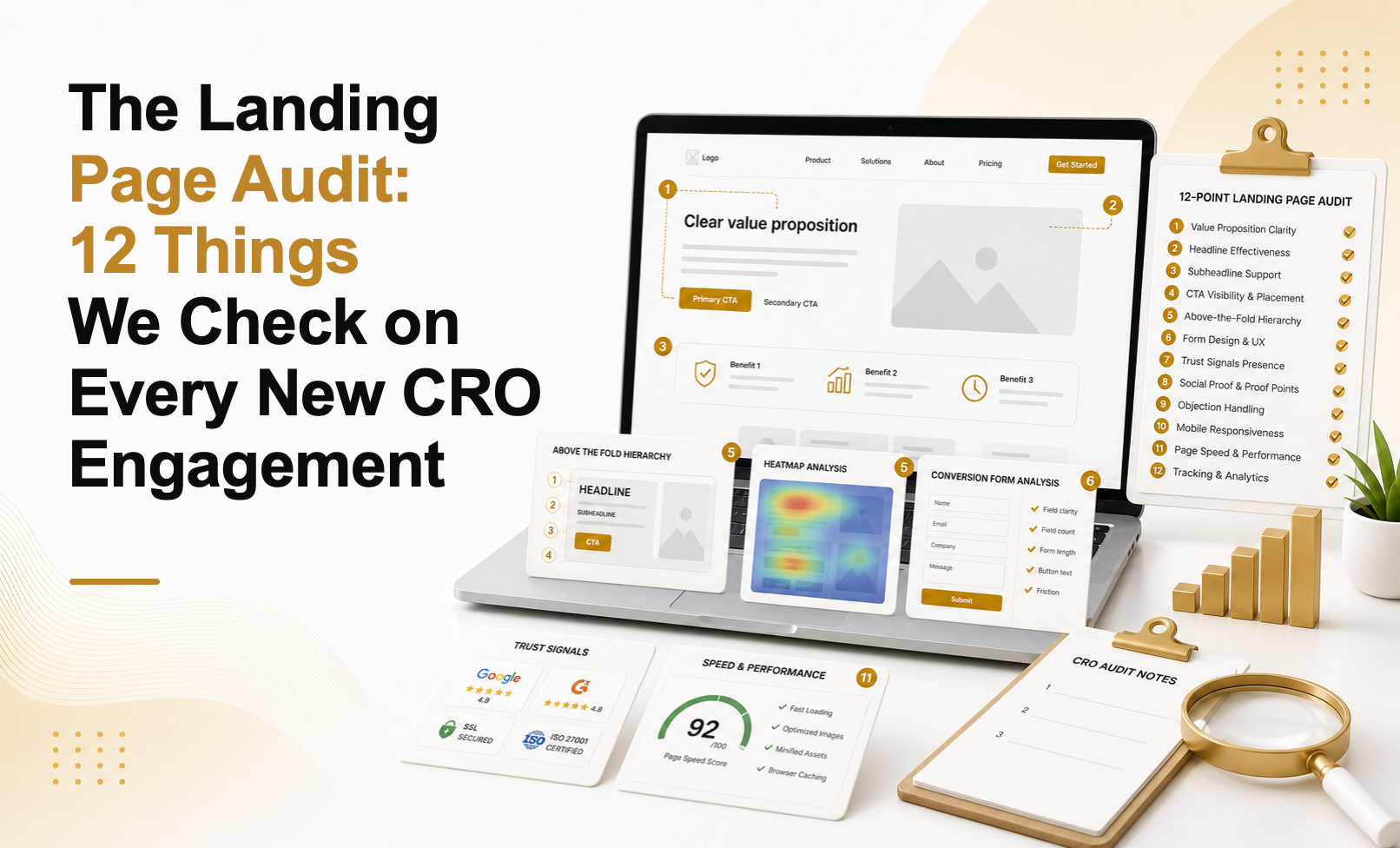
The audit below is the exact framework our team runs at the start of every new CRO engagement. We check these 12 elements in order, because the order reflects the hierarchy of impact — the earlier items on the list cause more conversion loss than the later ones, and fixing them delivers faster, larger returns. Use this checklist against your own landing pages and be honest about what you find.
Above the Fold: Checks 1 to 4
The first four checks all relate to what a visitor sees before they scroll. For most landing pages, this is where the majority of conversion loss occurs — not because visitors scroll to the bottom and decide not to convert, but because they leave within the first fifteen seconds without ever scrolling at all.
Check 1: Message Match
Does the headline on your landing page match the specific ad, email, or post that sent the visitor there? Message match is the single biggest conversion killer we find on Malaysian landing pages, and it is almost always the result of driving all traffic from a campaign to one generic page rather than creating matched destinations for different ad groups.
The mechanism is straightforward: a visitor who clicks an ad that says "Google Ads Agency Malaysia — Improve Your ROAS" has a specific expectation when they click. If they land on a page titled "Digital Marketing Solutions for Growing Businesses," that expectation is not met. The brain registers a mismatch, the visitor questions whether they are in the right place, and they leave. This happens in seconds, below the level of conscious deliberation. The visitor does not think "this doesn't match" — they simply lose confidence and bounce.
The fix is to audit the headline of every landing page against the ads pointing to it. The headline does not need to be word-for-word identical to the ad copy, but it must clearly and immediately confirm that the visitor is in the right place for the thing they were searching for.
Check 2: Clarity of Offer
Can a new visitor understand what you do, who it is for, and what they should do next within five seconds of arriving on your page? Test this with the squint test: blur the page until text is unreadable, then assess what structural elements still communicate. If your value proposition disappears when the copy is illegible, it is not being communicated effectively enough through hierarchy, contrast, and layout.
Malaysian B2B landing pages frequently fail this check because they try to communicate too much above the fold. A headline, a subheading, three benefit bullets, a client logo strip, and a form — all competing for attention simultaneously — communicate nothing with clarity. One primary message, one primary CTA, supporting context. That is the structure that converts.
Check 3: Primary CTA Visibility
Is there one clear, prominently placed call to action above the fold? The operative word is one. Multiple competing CTAs — "Book a Call," "Download Our Brochure," "Learn More," and "View Case Studies" all present in the above-fold area — fragment the visitor's attention and reduce conversion on all of them simultaneously. Every additional CTA option dilutes the conversion rate of your primary action.
Choose the one action that aligns most directly with the campaign objective and make it the unmistakable focal point of the page. Secondary options can exist below the fold for visitors who need more information before committing, but the primary CTA should dominate the above-fold experience.
Check 4: Load Speed on Mobile
Malaysia's mobile internet penetration is 97 percent. The majority of your landing page visitors — including B2B visitors clicking LinkedIn and Google Ads on their phones — are on mobile. If your page takes more than three seconds to load on a mobile connection, you are losing Malaysian visitors before they have read a single word.
The benchmark we target for client pages is a Largest Contentful Paint (LCP) of under 2.5 seconds on a mobile connection. Check your page speed using Google PageSpeed Insights and prioritise the mobile score — not the desktop score. Common culprits on Malaysian brand pages include uncompressed hero images (frequently 2 to 4 MB on pages that should serve 200 KB images), render-blocking JavaScript from tag management scripts loaded in the wrong order, and third-party chat widgets that load before any page content.
Trust Signals: Checks 5 to 8
Once a visitor has established in the first five seconds that they are in the right place, they face a second question: can they trust this business enough to submit their details? Trust signals answer that question. Their placement, specificity, and format all affect how effectively they do their job.
Check 5: Social Proof Placement
Where do your client logos, testimonials, or case study references appear on the page? If the answer is "in the footer" or "on a separate page linked from here," they are not working as conversion levers. Social proof should appear within the first full scroll — ideally immediately below the hero — because this is where the visitor's trust question is most active.
Malaysian B2B buyers trust peer validation heavily. A recognisable client logo from a Malaysian enterprise brand carries more conversion weight than a written testimonial from an unnamed "Marketing Director at a KL-based company." Where you have permission to show named, recognisable clients, do so. Where you do not, use specific results metrics rather than generic praise.
Check 6: Specificity of Claims
Replace every generic performance claim on your page with a specific, verifiable one. "We deliver results" is noise — it appears on every competitor's page and is ignored accordingly. "We reduced cost per lead by 43 percent for a Kuala Lumpur-based SaaS company within 90 days of engagement" is proof that demands attention.
Audit every claim on your landing page for specificity. Numbers, timeframes, company types, and named outcomes convert better than adjectives. "Faster results" versus "68 percent improvement in lead volume within 60 days." The former is ignored; the latter provokes the question "how did you do that?" — which is exactly the mental state that leads to form submission.
Check 7: Contact Information Visible
Malaysian B2B buyers want to know there is a real business behind the page before they submit their details. A visible phone number, a physical address or at minimum "Based in Kuala Lumpur," and a professional business email address (not a Gmail) in the header or above-fold area consistently increases form submission rates. This is particularly true for first-time visitors arriving from cold paid traffic — they have no prior relationship with your brand and are assessing legitimacy rapidly.
This check is often skipped by brands that assume their website is already well-known enough to carry trust implicitly. On a landing page receiving cold paid traffic, that assumption is almost always wrong. Make the contact information visible, even if most visitors will never use it. Its presence does the trust work passively.
Check 8: Privacy and Security Signals
Malaysia's Personal Data Protection Act (PDPA) enforcement has increased significantly, and Malaysian audiences — particularly in regulated sectors like financial services and healthcare — are more attuned to data privacy than they were three years ago. Three signals matter on landing page forms: the SSL padlock in the browser bar (confirm your page is served over HTTPS), copy near the form field that explicitly states you will not spam or sell their data, and a PDPA compliance note or link to your privacy policy.
These are not legal formalities — they are conversion signals. "We respect your privacy and will never share your details" directly above the Submit button addresses the objection the visitor is most likely forming at the exact moment they are forming it. In Malaysian B2B markets where data handling trust is a genuine concern, these signals measurably reduce form abandonment.
Conversion Mechanics: Checks 9 to 12
The final four checks address the mechanical elements of the conversion action itself — the form, the button, the mobile experience, and what happens immediately after submission. These are the elements that determine whether a visitor who has been persuaded by everything above actually completes the intended action.
Check 9: Form Length
Every additional field in a form reduces submission rate by approximately 11 percent. This is not a guideline — it is a consistent finding across conversion research spanning thousands of landing page tests. A form with six fields converts substantially worse than a form with five, and a form with eight fields converts roughly half as well as a form with four.
For Malaysian B2B lead generation, the maximum form length we recommend is four to five fields: name, company name, email address, phone number, and one qualifying question relevant to your sales process. "What is your current monthly ad spend?" or "How many employees does your company have?" — one question that gives your sales team a meaningful signal about lead quality without adding enough friction to suppress volume. Anything beyond five fields requires specific justification based on your sales qualification process, not a general assumption that more information is always better.
Check 10: CTA Button Copy
"Submit" is the worst performing CTA button copy in conversion research, and it remains the most commonly used. It describes what the visitor is doing (submitting a form) rather than what they are receiving (value). The cognitive effect of generic submit copy is to frame the interaction as a transaction where the visitor gives something (their data) and receives nothing specific in return.
Replace submit copy with benefit-led, action-specific copy that states what happens next: "Get My Free Audit," "Book My Strategy Call," "Download the Report Now," "Start My Free Trial." The button copy should complete the sentence "I want to ___." If that sentence does not read as a desire, the copy is not working. In our client accounts, switching from "Submit" to action-led CTA copy produces measurable conversion rate improvement in the 8 to 18 percent range with no other page changes.
Check 11: Mobile Form Experience
Testing your form on a desktop browser in mobile responsive view is not the same as testing it on an actual mobile device. The differences that browser simulation misses are the ones that cost you conversions: input field size relative to finger tap target, keyboard type triggered by different field inputs (email fields should trigger the email keyboard, phone fields should trigger the numeric keyboard, text fields the full QWERTY), autocomplete behaviour, and the visual positioning of the submit button relative to the active keyboard when it is raised.
Test your form on actual devices — at minimum an iPhone and an Android handset — at the start of every campaign. Walk through the entire form completion flow as if you were a new visitor. Note every point of friction: fields that are too small to tap accurately, keyboards that obscure the button, fields that do not accept the paste action from a password manager. Each of these friction points is costing you form completions from the 97 percent of your Malaysian audience who are on mobile.
Check 12: Thank You Page and Follow-Up
The thank you page is the most consistently under-optimised page on Malaysian marketing sites, and it represents a significant missed opportunity. After a prospect has overcome every barrier and completed the conversion action, the thank you page is the highest-engagement moment of the entire user journey. What happens there determines whether the momentum of the conversion is sustained or squandered.
An effective thank you page does three things: it confirms the specific next step ("A member of our team will call you within 24 business hours"), it sets expectations on timing ("We'll be in touch before end of day tomorrow"), and it offers a secondary action that keeps the prospect engaged with your content while they wait ("Download our latest Malaysian digital marketing benchmarks report while you wait"). This secondary action is particularly important for B2B purchases with long decision cycles — staying present in the prospect's mind between form submission and first sales contact is a genuine competitive advantage.
For our Web & CRO clients, the thank you page optimisation is often among the highest-return interventions because it costs almost nothing to improve and it operates at the highest-intent moment in the entire funnel.
What to Fix First
Not all 12 checks carry equal weight, and attempting to fix all of them simultaneously creates two problems: it makes attribution impossible (you will not know which fix drove the improvement) and it creates unnecessary implementation burden. Prioritise by impact category.
Fix this week (critical):
- Message match between ads and landing page headlines
- Primary CTA — one, visible, above the fold
- Mobile load speed (target LCP under 2.5 seconds)
- Form length — reduce to a maximum of five fields
These four items account for the majority of conversion loss on most Malaysian landing pages. A page that gets all four right will convert meaningfully better than one that has everything else optimised but these fundamentals broken.
Fix this month (important):
- Social proof placement — move above the fold or to the first scroll section
- Mobile form experience — test on real devices
- CTA button copy — replace "Submit" with benefit-led copy
- Contact information — make visible above the fold
Optimise ongoing:
- Thank you page content and secondary CTA
- Privacy and PDPA signals near form fields
- Specificity of performance claims
- Form field order and label copy
The diagnostic tool for prioritisation is your analytics data. Use GA4 or a scroll mapping tool like Hotjar to identify where on the page visitors are abandoning. If 60 percent of visitors leave without scrolling past the hero, the above-fold checks are your priority. If visitors scroll through the page but abandon at the form, the conversion mechanics checks are where the problem lives. Let data determine the order, not intuition.
How to Test Changes Without Wasting Data
The most common testing mistake on Malaysian landing pages is changing multiple elements simultaneously. If you update the headline, shorten the form, and change the CTA button copy at the same time, and conversion rate improves by 22 percent, you have no idea which change drove the improvement — or whether one of the three changes was actually reducing performance while the others overcame it. You cannot learn from a multi-variable change, which means you cannot build on it systematically.
A/B test one variable at a time in isolation. Define the hypothesis before you start: "Changing the CTA button from 'Submit' to 'Get My Free Audit' will increase form completion rate." Run the test. Measure the specific metric. Draw a conclusion. Then move to the next variable.
Statistical significance requires minimum sample sizes that many Malaysian B2B landing pages cannot reach quickly. As a general guideline, you need a minimum of 500 visitors per variant before drawing conclusions — and 1,000 per variant to be confident in the result. For a page receiving 200 visitors per month, reaching 500 per variant takes at least five months per test. That is not a viable testing programme.
For Malaysian B2B sites with fewer than 2,000 monthly visitors, traditional A/B testing is statistically unreliable. The correct approach is to implement best practices directly rather than test into them — the 12 checks above represent established conversion principles validated across thousands of landing pages. Implement them, measure the aggregate improvement over 60 to 90 days compared to the prior period, and then move to A/B testing once traffic volume makes it statistically viable.
For testing tools: Google Optimize has been deprecated — the current market alternatives are VWO, Optimizely, and AB Tasty, all of which have free tiers adequate for low-traffic sites. For qualitative insight — understanding why users are not converting rather than just how many — Hotjar provides session recordings and scroll heatmaps that reveal behaviour patterns invisible in quantitative data. GA4 funnel exploration reports identify the specific steps in the conversion journey where drop-off is highest, which is the correct starting point before any test is designed.
One final point on testing discipline: document your tests. Many Malaysian marketing teams run informal "let's try this" experiments that produce results but are never recorded, which means the same experiment is repeated six months later when team members change. A simple shared log — date, hypothesis, variable changed, result, conclusion — is all that is required. It compounds into a genuine knowledge base about what converts your specific audience over time.
Landing page optimisation is not a one-time project. It is an ongoing process of observation, hypothesis, implementation, and measurement. The brands in Malaysia that are consistently outperforming their competitors on conversion rate are not doing so because they found a magic headline or a perfect button colour — they are doing so because they have been running this process systematically for twelve months or more. The 12 checks above are the starting point. The competitive advantage is built by making them a permanent part of how you operate.