Why Crossing the Causeway Is Harder Than It Looks
On the surface, a Malaysian brand expanding into Singapore seems almost trivial. Both markets speak English. Both run on Google and Meta. Both have mobile-first consumer behaviour and a healthy e-commerce culture. The internal pitch meeting probably involved phrases like "adjacent market" and "low-hanging fruit."
The reality that surfaces within the first two to three months of live spend is considerably less straightforward. Singapore and Malaysia share proximity but diverge sharply on almost every dimension that matters to a performance marketer: language register, cultural reference points, price sensitivity, competitive density, and platform cost structure.
The language issue alone trips up most expansion attempts. Singapore English — Singlish — carries different rhythm, different vocabulary, and different emotional cues than Malaysian English. Copy written in Kuala Lumpur that feels natural, warm, and direct often lands as either overly casual or culturally misplaced when served to a Singapore audience. B2B copy that performs in Malaysia may read as under-authoritative to a Singapore procurement manager who compares vendors against firms like Accenture and KPMG on a regular basis.
Beyond language, competitive density is the structural shock. In Malaysia, a challenger brand can buy its way into the top three positions on a competitive keyword for a manageable CPC. In Singapore, those same positions are contested by regional and global players with significantly larger budgets, which drives CPCs and CPMs to levels that can break a Malaysian brand's unit economics before a campaign has had time to generate meaningful data.
Brands that assume their Malaysian creative, keyword lists, and targeting parameters will transfer intact to Singapore typically burn 40 to 60 percent of their first three months' budget learning this the expensive way. The playbook below is designed to compress that learning curve.
Understanding the Audience Differences That Matter for Performance
The population difference is the first structural reality you need to build your media plan around. Malaysia has roughly 33 million people. Singapore has 5.9 million — and once you apply relevant demographic filters (age, income, job function for B2B), your actual reachable audience on any given platform is a fraction of what you are used to targeting in Malaysia.
Smaller audience pools drive higher CPMs directly. Meta's auction system responds to scarcity. When fewer users are available to show an ad to, the cost of reaching each one increases — and in Singapore, that dynamic is structural, not seasonal. This means that scaling spend does not work the same way it does in Malaysia. You cannot simply triple the budget and expect three times the reach. You will hit audience saturation faster, and frequency fatigue will arrive earlier.
Income per capita in Singapore is among the highest in Southeast Asia, which changes purchase triggers fundamentally. Malaysian consumers are responsive to absolute price — promotional pricing, bundle deals, and instalment schemes are effective conversion levers. Singapore consumers place comparatively more weight on quality signals, brand credibility, and peer validation. The same promotional mechanics that drive conversion in KL can actually suppress conversion in Singapore by signalling that a brand competes on discount rather than value.
The ethnic composition of Singapore also requires deliberate creative strategy. Singapore's population is approximately 76 percent Chinese, with a significant proportion who are Mandarin-first. English-language campaigns will reach the broad market, but Mandarin creative opens a channel that most Malaysian brands entering Singapore completely ignore — and that channel is often less expensive to reach because fewer advertisers compete for it.
For B2B campaigns specifically, the procurement environment in Singapore is more formalised than Malaysia. Buying committees are larger. Legal and finance sign-off is standard on contracts above a certain threshold. Sales cycles are longer. This means B2B content needs to be more authoritative — whitepapers, case studies with named clients, industry data — not the more informal lead-generation creative that performs well in Malaysian B2B contexts.
The same ad that converts in KL might feel too casual or too price-focused for a Singapore audience. The buying psychology is different enough that adapting creative is not optional — it is a prerequisite for acceptable cost-per-lead.
Paid Media: What Changes on Google and Meta
Google Ads is where the volume gap hits hardest. For most B2B and services-related search terms, Singapore generates search volumes that are 60 to 80 percent lower than equivalent Malaysian terms. A keyword that drives 5,000 monthly searches in Malaysia might generate 800 to 1,200 in Singapore. This is not a problem — but it requires a different campaign architecture.
In Malaysia, broad match and broad match modifier strategies can work because there is enough volume to feed machine learning and generate meaningful statistical data within a reasonable timeframe. In Singapore, broad match on low-volume terms creates campaigns that spend weeks accumulating irrelevant clicks before Smart Bidding has enough signal to optimise. Tighter keyword match types, tighter ad groups, and more conservative initial targeting give you cleaner data faster.
Quality Score becomes more important in Singapore's Google Ads environment because it directly affects your ability to win auctions at a competitive cost. With fewer auction opportunities available (due to lower search volume), you cannot afford to have mediocre ad relevance dragging your impression share down. Singapore-specific ad copy, Singapore-specific landing pages, and intent-matched headlines are not nice-to-haves — they are the difference between an economically viable CPC and one that breaks your model.
On Meta, the cost structure is the primary adjustment. Singapore CPM typically runs SGD 18 to 28 for most audience segments, compared to MYR 8 to 14 in Malaysia. In absolute SGD-to-MYR terms, a Singapore Meta campaign costs roughly four to five times as much to reach the same number of people. Budget planning that is built on Malaysian benchmarks will be significantly underfunded for Singapore.
The bidding strategy adjustment is critical and often overlooked. Malaysian accounts typically have months or years of conversion data that informs Smart Bidding — tROAS and tCPA strategies are calibrated to Malaysian user behaviour, Malaysian conversion rates, and Malaysian pricing. None of that carries over to Singapore. Launching in Singapore with Smart Bidding strategies inherited from Malaysia is one of the fastest ways to waste budget. Start with manual CPC or Maximise Clicks, run for four to six weeks to accumulate conversion data specific to the Singapore market, then transition to automated bidding with Singapore-calibrated targets.
Lookalike audiences built from Malaysian customer data will also underperform in Singapore. The Meta algorithm builds lookalikes from behavioural signals within a defined geography. A lookalike of your Malaysian customers will find Singapore users who exhibit similar in-platform behaviour — but that behavioural similarity does not necessarily correlate with purchase intent in the Singapore market. Build Singapore-specific seed audiences from your first weeks of traffic, even if that seed list is small, and expand from there.
For a detailed breakdown of paid search and paid social strategy in either market, see our PPC & Paid Media services page.
Creative and Messaging Localisation
Creative localisation for Singapore goes beyond replacing "RM" with "SGD" and swapping Petronas Towers for Marina Bay Sands. The adjustments that actually move performance metrics are subtler and deeper than visual asset changes.
Price anchoring is the most immediately impactful adjustment. Malaysian performance creative frequently leads with price — promotional banners, percentage discounts, and price comparison frames are standard and effective conversion tools. In Singapore, leading with price signals discount positioning, which can actively deter the higher-income consumer segments you are trying to attract. Reframe around outcomes, quality signals, and peer validation. "Trusted by 200+ Singapore enterprises" will outperform "Starting from SGD 299/month" in most B2B Singapore contexts.
Tone calibration requires attention, particularly for B2B. Malaysian marketing copy tends toward the warm and relational — it uses first names, direct address, and conversational register effectively because that matches the cultural communication style. Singapore B2B copy needs to project competence and authority more explicitly. That does not mean the copy should be cold or corporate — it means the balance shifts toward demonstrating expertise before establishing rapport, rather than the other way around.
Visual context matters more than most brands realise. Singapore audiences see hundreds of ads per day set against the specific visual landscape of their city: the CBD skyline, Raffles Place, Marina Bay, Orchard Road, the specific aesthetic of Singapore's interior design and retail environments. Ads featuring KL-specific visual contexts — or generic stock photography with no geographic anchoring — are processed as "foreign" at a subconscious level, which reduces emotional engagement and conversion likelihood.
Cultural event alignment also needs recalibration. Merdeka campaigns do not run in Singapore — National Day is August 9. Hari Raya campaigns are still relevant (Singapore has a significant Malay Muslim community), but the timing, the cultural references, and the tonal register may differ from Malaysian campaigns. Chinese New Year campaigns can often be adapted more directly, though Singapore CNY creative tends to skew slightly more premium in visual treatment.
Social proof localisation is the piece most Malaysian brands leave until last and should be doing first. Singapore decision-makers weight Singapore-based references heavily. A case study from a Malaysian company means significantly less to a Singapore procurement committee than a case study from a recognisable Singapore brand. If you have any Singapore clients — even early adopters — lead with them. If you do not, frame your credentials as "Malaysia & Singapore" and be explicit about your regional footprint. The credibility gap closes faster with regional framing than with simply presenting Malaysian references as implicitly applicable.
SEO: Building Authority in a New Market
Singapore's search marketing landscape for agency and professional services categories is significantly more competitive than Malaysia's equivalent. "Digital marketing agency Singapore" is a keyword contested by dozens of established local agencies, regional networks, and international consultancies — many of whom have been building domain authority and local link profiles for a decade or more. Entering that competition directly on day one is an expensive strategy with a long payback horizon.
The more efficient entry point for most Malaysian brands expanding into Singapore is comparative or regional content — articles, guides, and data pieces that explicitly address the Malaysia-Singapore context. These terms carry lower competition because established Singapore agencies do not tend to write about Malaysia, and Malaysian brands who have not yet expanded do not write about Singapore. You occupy a genuinely uncrowded position.
Content like "digital marketing costs in Singapore vs Malaysia," "how to expand your brand from Malaysia to Singapore," and "performance marketing benchmarks across Southeast Asia" rank in a space where your existing Malaysian domain authority is an asset rather than a handicap. Once you have established traffic and topical authority in that comparative space, you can expand into more Singapore-specific terms with the benefit of demonstrated relevance.
Within your domain structure, you have options for geo-targeting: a dedicated .sg domain builds the clearest geographic signal for Singapore search, but a subfolder structure (yourdomain.com/sg/) within your existing domain preserves domain authority consolidation and is faster to implement. For most Malaysian brands at the point of initial expansion, the subfolder approach is the pragmatic choice — you begin building Singapore-specific SEO equity without splitting your link profile or maintaining two separate domain authorities.
Backlink development in Singapore requires targeting Singapore-specific publications. Links from Malaysian publications carry full SEO value, but Singapore's Google algorithm responds to Singapore-origin domain signals for Singapore-targeted searches. Publications like The Business Times, Channel NewsAsia, and Tech in Asia carry strong domain authority and are reachable through press releases, contributed content, and data-led research pieces that generate editorial interest.
See our SEO & Content services page for how we approach market-entry SEO for regional expansion campaigns.
The Right Channel Mix for Singapore Market Entry
One of the most common strategic errors in Singapore market entry is launching all channels simultaneously. The logic is understandable — you want coverage, you want to learn fast, and you want to maximise the launch window. The practical result is diluted budget across too many channels, insufficient data in any single channel to make meaningful optimisation decisions, and a budget bleed rate that causes brands to pull out of Singapore before they have had time to learn anything useful.
A phased channel strategy compresses the learning curve while managing spend efficiently. In months one through three, paid search should be your primary channel — it captures existing demand from users who are already searching for what you offer, it generates fast conversion data, and it allows you to test and refine Singapore-specific messaging through ad copy performance. LinkedIn should run alongside paid search for B2B brands, not as a conversion channel but as an awareness channel — building recognition with the Singapore professional audience who will later search for you or respond to retargeting.
Landing page testing is critical during this phase. Your Singapore traffic is too valuable and too expensive to send to Malaysian landing pages that have not been adapted. Build Singapore-specific landing pages before launch — adapted copy, Singapore social proof, SGD pricing — and use the paid search traffic to run conversion rate optimisation from week one.
In months three through six, you should have enough Singapore-specific conversion data to identify your best-performing audience segments, ad formats, and messaging angles. This is when you begin scaling what is working, layer in Meta retargeting to re-engage users who visited but did not convert, and start building your SEO content pipeline with the learnings from paid search (which keywords, which intent signals, which value propositions generate engagement).
From month six onwards, programmatic display and out-of-home digital advertising become viable for brand building once you have established enough market presence that broader reach investment will compound on existing awareness rather than disappear into a void. Influencer partnerships and event sponsorship in Singapore are expensive relative to Malaysia and should be considered only once you have validated product-market fit and conversion economics through performance channels first.
For a full view of how we structure multi-channel strategies for regional expansion, see our services overview.
The 90-Day Singapore Entry Playbook
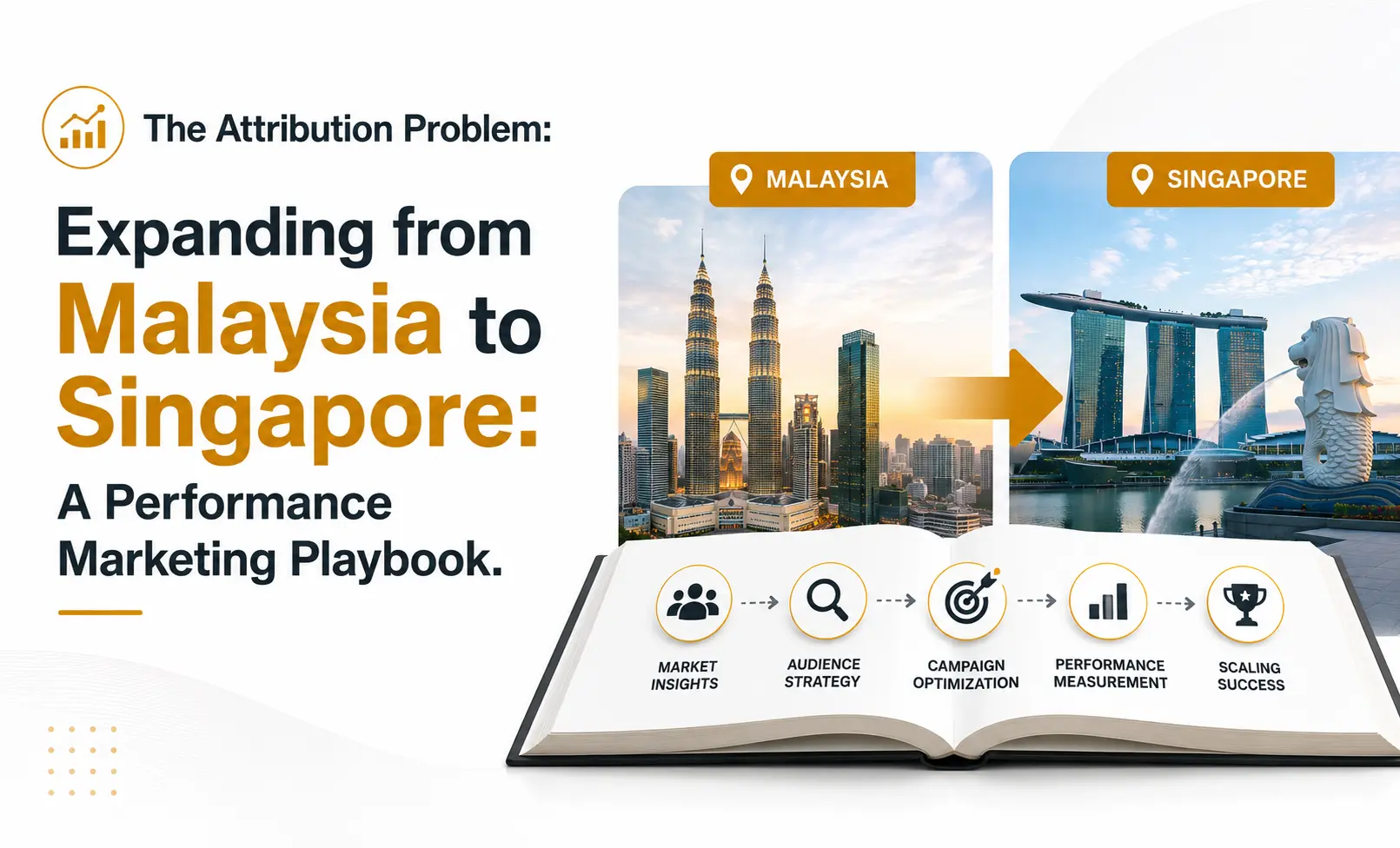
The following is the framework we use when onboarding a Malaysian brand for Singapore market entry. It is not a template — actual timelines, budgets, and channel priorities vary by category, company size, and existing brand recognition. It is a sequence of actions that reduces the risk of the most common and costly mistakes.
Weeks 1–2: Asset Audit and Gap Analysis. Before a single dollar of Singapore spend goes live, audit every existing marketing asset for Singapore relevance. This includes the website (does it address Singapore at all?), landing pages (do they reference MYR pricing, Malaysian case studies, Malaysian-specific brand references?), ad creative libraries (is there anything that can be adapted vs what needs to be built fresh?), and keyword lists (have you pulled Singapore search volume data or are you working from Malaysian volume assumptions?).
The output of this audit is a gap list: the specific assets that need to be created, adapted, or suppressed for Singapore. Prioritise the gaps by their direct impact on conversion — landing page adaptation ranks higher than social media bio updates.
Weeks 3–4: Singapore Infrastructure Build. Build the assets identified in your gap analysis. Singapore-specific landing pages, adapted ad copy variants (at minimum two or three copy angles to test), Singapore keyword lists with accurate local search volumes, and a Singapore-specific conversion tracking setup in GA4 that keeps Singapore data segmented from Malaysia from day one. Commingled analytics is one of the most persistent errors in cross-border expansion — if your Singapore and Malaysia data mix in the same GA4 property without clear segmentation, you will never be able to accurately evaluate Singapore performance.
Month 2: Paid Search Launch. Launch paid search with an SGD-denominated budget. The exact figure depends on your category and competitive intensity, but a meaningful minimum for most B2B categories in Singapore is SGD 3,000 to 5,000 per month — below that, the data accumulation rate is too slow to make meaningful optimisation decisions within a reasonable timeframe. Track conversions separately from Malaysia. Do not compare SGD cost-per-lead to your MYR cost-per-lead — they are different markets with different cost structures, and the comparison is not operationally meaningful.
Months 2–3: Creative A/B Testing. Run concurrent creative tests comparing adapted Malaysian creative against Singapore-native creative. Specifically test the price-anchor framing, the social proof elements, and the tone register. The data from these tests will inform not just your paid creative but your broader Singapore content strategy.
Month 3: Data Review and Planning Pivot. At the end of the first three months, you should have enough data to make a genuinely informed decision about Singapore. What is your actual cost per qualified lead in SGD? Which audience segments are converting? Which ad copy angles are resonating? Which landing pages are converting at an acceptable rate? Use this data to build your month four through six plan — double down on what is working, cut what is not, and begin the SEO content calendar based on the search terms you have validated through paid.
The single most important metric at the 90-day mark is cost per qualified lead in SGD — not impressions, not click-through rate, not website traffic. If your CPL is within a range that makes commercial sense for your sales model and average contract value, Singapore is worth continuing to invest in. If it is not, the question is whether the gap is a structural market problem or an execution problem that further optimisation can solve. Both are answerable — but only if your data is clean enough to diagnose accurately from the start.