The LinkedIn Malaysia Reality Check
LinkedIn has approximately 4.5 million users in Malaysia — a fraction of its global 1 billion member base, and tiny compared to Meta's 22 million Malaysian users. That number is important context for everything that follows, because almost every structural problem with LinkedIn campaigns in Malaysia flows from it.
B2B marketers in Malaysia have embraced LinkedIn as the answer to pipeline problems, and the logic is sound in theory. If you want to reach the Head of IT at a 200-person manufacturing firm in Selangor, LinkedIn is genuinely the only platform where you can do that with precision. No other channel lets you filter by seniority, function, company size, and industry simultaneously. The targeting capability is real.
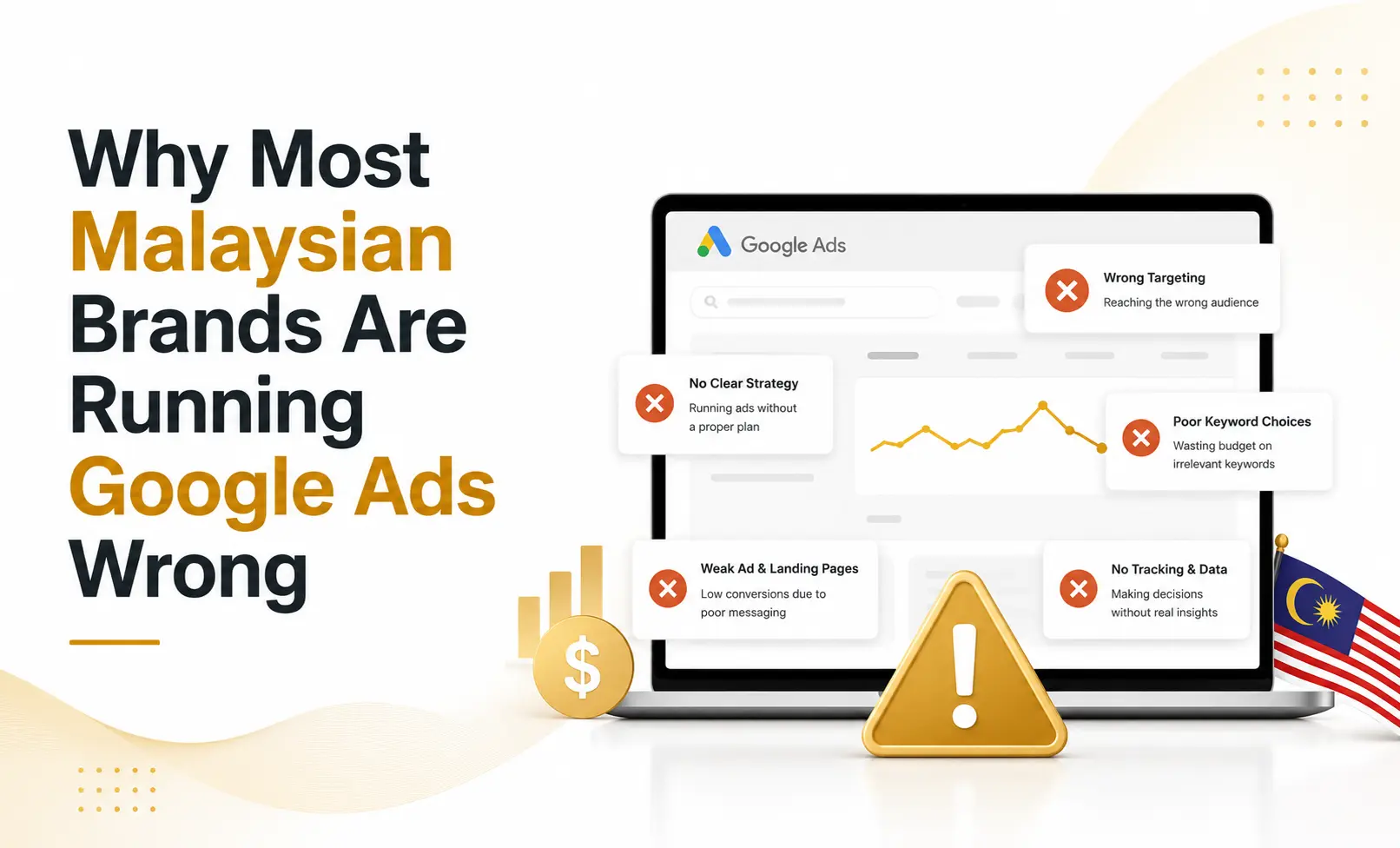
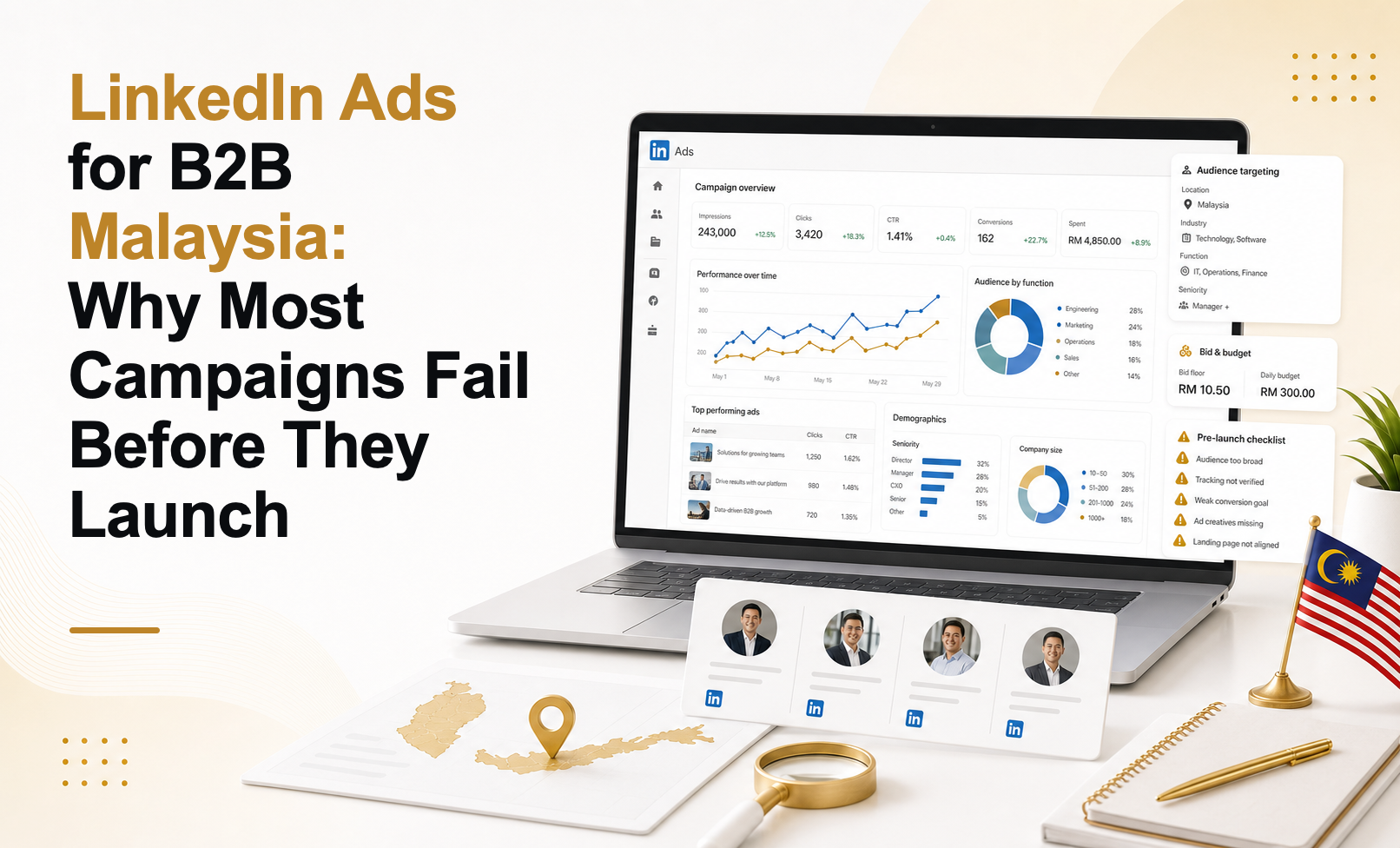
The failure is almost always structural, not creative. Brands launch LinkedIn campaigns with budgets calibrated for Facebook, targeting strategies borrowed from Google Ads playbooks, and creative assets designed for a social feed that operates by entirely different rules. The result is poor performance, budget exhaustion, and a conclusion that "LinkedIn doesn't work in Malaysia." That conclusion is wrong — but the structural diagnosis is correct: most LinkedIn campaigns are set up to fail before the first impression is served.
Understanding why campaigns fail requires looking at three distinct problem areas: audience size, bidding floors, and creative mechanics. Each one is solvable. None of them are obvious until you have run enough LinkedIn campaigns in this market to see the patterns clearly.
The Audience Size Problem That Kills Most Campaigns
LinkedIn's Campaign Manager requires a minimum audience size of approximately 50,000 members for most campaign types to function effectively. Below that threshold, the platform's delivery algorithm has too little room to optimise — frequency caps are hit within days, CPM climbs as the pool exhausts, and performance collapses before the campaign has had time to generate meaningful data.
The problem is that Malaysian LinkedIn audiences are almost always smaller than marketers expect. When a B2B SaaS company in KL targets "Marketing Managers and above at companies with 50–500 employees in Klang Valley," they might anticipate a substantial audience. In practice, that query typically returns 8,000 to 15,000 members. That is not a viable campaign audience — it is barely large enough to avoid immediate ad fatigue.
This plays out predictably: the first week of the campaign looks promising as LinkedIn serves ads to the most responsive members of that small pool. By week two, frequency is climbing and CPM is rising as the algorithm cycles back to the same people. By week three, click-through rate has dropped by 40 to 60 percent and the campaign manager is reporting performance decline. The problem is not the creative or the offer — it is the fundamental size of the addressable pool.
The fix requires expanding strategically rather than randomly. The right approach is to broaden targeting parameters while maintaining intent. Expanding the seniority filter from Director+ to Manager+ in a B2B context often triples audience size without meaningfully reducing lead quality — Managers are frequently the people who drive vendor evaluation even if Directors sign off. Expanding geography from Klang Valley to all of Malaysia, or for campaigns where it is appropriate, including Singapore and Indonesia, can multiply audience size while reaching genuine prospects. Matched Audiences — uploading your CRM contact list or website visitor list for LinkedIn to match against its member database — add a qualified layer on top of the targeting that often improves both audience size and lead quality simultaneously.
A LinkedIn audience under 30,000 is almost always too small to run efficiently for more than two weeks. If your targeting precision yields a small audience, broaden the parameters rather than accept a campaign that will collapse from ad fatigue.
Bidding Floors and What They Mean for Your Budget
LinkedIn's auction has minimum bids that many marketers discover too late. Depending on the campaign type and objective, LinkedIn imposes minimum bids — often USD 4 to 6 CPM for Sponsored Content or USD 2 to 3 CPC for click-based objectives. These are floors, not averages. In a competitive B2B audience, the actual clearing price is substantially higher.
For Malaysian B2B campaigns, real-world clearing prices for Sponsored Content typically land between USD 8 and USD 15 per click — which translates to roughly RM 38 to RM 70 per click at current exchange rates. For comparison, a well-managed Google Ads campaign targeting bottom-of-funnel B2B keywords in Malaysia might cost RM 5 to RM 18 per click for comparable intent. LinkedIn's precision carries a significant premium.
What does this mean practically? A monthly budget of USD 3,000 — approximately RM 14,000 — buys between 200 and 375 clicks. If your landing page converts at 3 percent (which is optimistic for cold LinkedIn traffic), that is 6 to 11 leads per month. At the lower end, you are paying RM 2,300 per lead before any sales qualification has taken place. This is not a reason to avoid LinkedIn, but it is a reason to be clear-eyed about the funnel economics before committing budget.
The minimum viable monthly budget for LinkedIn lead generation in Malaysia that we recommend is RM 8,000 to RM 15,000. Below RM 8,000, the campaign lacks the statistical volume to optimise and lacks the impression frequency to build the brand familiarity that LinkedIn requires before a cold prospect will convert. Below RM 5,000, you are essentially paying for market research data, not lead generation — which can be a valid objective, but should be named as such.
For campaigns where budget is constrained, retargeting is significantly more efficient than cold prospecting. Retargeting website visitors or LinkedIn video viewers on LinkedIn typically delivers CPLs 30 to 50 percent lower than cold Sponsored Content, because the audience already has some familiarity with the brand. If budget is the constraint, prioritise retargeting first and expand to cold prospecting only when budget allows.
Which Ad Formats Actually Work for Malaysian B2B
LinkedIn offers more ad formats than most platforms, and the differences in performance across Malaysian B2B audiences are significant enough to warrant format-specific guidance rather than generic advice.
Sponsored Content (Single Image): The workhorse format. Works well for thought leadership, brand awareness, and driving traffic to high-value resources. Carousel ads within Sponsored Content suit multi-feature product announcements or step-by-step educational content. This is where most B2B brands should start because the learning curve is lowest and the format is most familiar to audiences.
Lead Gen Forms: The highest-performing conversion format on LinkedIn for Malaysian B2B campaigns. Native forms — where prospects submit details without leaving LinkedIn — consistently outperform landing page redirects by 2 to 3 times in form completion rate. The reason is friction: LinkedIn pre-fills name, company, title, and email from the member's profile. The prospect sees a form that is already 80 percent complete and only needs to click Submit. Keep Lead Gen Form fields to 4 to 5 maximum. Adding a sixth field — even one as logical as "company website" — measurably reduces completion rates. Ask for only what your sales team absolutely needs to qualify the lead.
Message Ads (InMail): High CPM, high unsubscribe risk, and limited volume due to LinkedIn's cap on how frequently any member can receive Message Ads. Use these sparingly and only for retargeting warm audiences — people who have already engaged with your content or visited your website. Sending cold Message Ads to a prospecting audience in Malaysia generates click rates well below 1 percent and erodes sender reputation within LinkedIn's system.
Conversation Ads: Branching message ads that let recipients choose their own path through a scripted dialogue. These work well for event registration and webinar promotion where the audience has multiple relevant entry points. Less suitable for direct lead generation because the branching complexity often distracts from conversion.
Document Ads: Promoted documents — white papers, industry reports, research studies — that members can preview natively in the feed and download. This format performs strongly for Malaysian professional audiences, particularly in sectors like financial services, technology, and professional services where long-form content carries credibility. Gate the document behind a Lead Gen Form and the CPL on Document Ads is often 20 to 30 percent lower than equivalent Sponsored Content, because the content value justifies the form completion.
For most Malaysian B2B advertisers, the optimal starting stack is Sponsored Content for top-of-funnel awareness combined with Lead Gen Forms for conversion — with Document Ads introduced once you have a gated asset worth promoting. Our PPC & Paid Media team runs this combination across the majority of our LinkedIn client accounts in Malaysia.
Creative That Converts on LinkedIn Malaysia
LinkedIn's feed is a professional environment, and the creative that works there follows different rules than Facebook or Instagram. Malaysian B2B audiences on LinkedIn are scanning for relevance to their professional context — they are not in discovery mode, they are in professional development mode. Creative needs to meet that intent.
The most important structural rule is the 150-character hook. LinkedIn truncates Sponsored Content copy after approximately 150 characters in the feed, before the "See more" prompt. Everything your ad needs to say to stop the scroll and communicate relevance must fit within that first sentence. If your opening line is a company name and a tagline, you have already lost most of your audience before they read anything substantive.
On visual assets: avoid generic stock photography. Malaysian professionals on LinkedIn respond more favourably to real team photos, actual product screenshots, data visualisations, and branded graphics with clear numerical claims than to aspirational lifestyle imagery. If your ad contains the phrase "helping businesses grow" over a photo of people smiling in a glass-walled office, it will be ignored. If your ad opens with "Malaysian SaaS companies spend an average of RM 4,200 per month on tools their teams don't use — here's how to audit yours," it stops the scroll.
Use statistics that are specific to the Malaysian or ASEAN market in headlines wherever possible. Regional specificity signals to a Malaysian decision-maker that the content is relevant to their context, not adapted from a US or UK playbook. The difference in click-through rate between a generic headline and a Malaysia-specific one in our campaign data is consistently 15 to 25 percent.
On CTAs: "Download Report" and "Register Now" consistently outperform "Learn More" and "Contact Us" in LinkedIn campaigns across Malaysian B2B categories. The former two communicate a clear, specific next action with immediate value; the latter two are vague and imply a commitment the prospect is not yet ready to make. Test your CTAs as rigorously as your headlines — the combination of the two is the primary driver of click-through rate.
Plan to test three to four creative variants minimum before drawing conclusions about what works for your audience. LinkedIn's Campaign Manager does not have the statistical power to optimise creative quickly with small audiences, so manual review and rotation is usually necessary. Set a frequency cap of 2 to 3 impressions per member per week to manage ad fatigue across the testing period.
Is LinkedIn Worth the Budget for Malaysian B2B?
The honest answer is: it depends entirely on your deal economics and sales cycle.
LinkedIn is the right channel if your average deal size justifies a CPL of RM 450 to RM 900, you operate a long B2B sales cycle where relationship-building and thought leadership matter, you are targeting decision-makers at Director, VP, or C-Suite level, and you can sustain three or more months of testing before judging performance. In these conditions, LinkedIn delivers pipeline that no other platform can reach — specifically, the senior decision-makers who do not click on Google Search ads because they are not actively looking for solutions. LinkedIn creates demand among people who will eventually become buyers; it does not primarily capture existing demand.
LinkedIn is the wrong channel if you are selling transactional products or services where purchase decisions are made quickly, your average deal size is below RM 20,000 annually, your margins do not support a RM 450 to RM 900 CPL, or you need leads within the next 30 days. In these situations, a well-managed Google Ads campaign targeting bottom-of-funnel B2B intent keywords will consistently deliver better ROI at lower CPL.
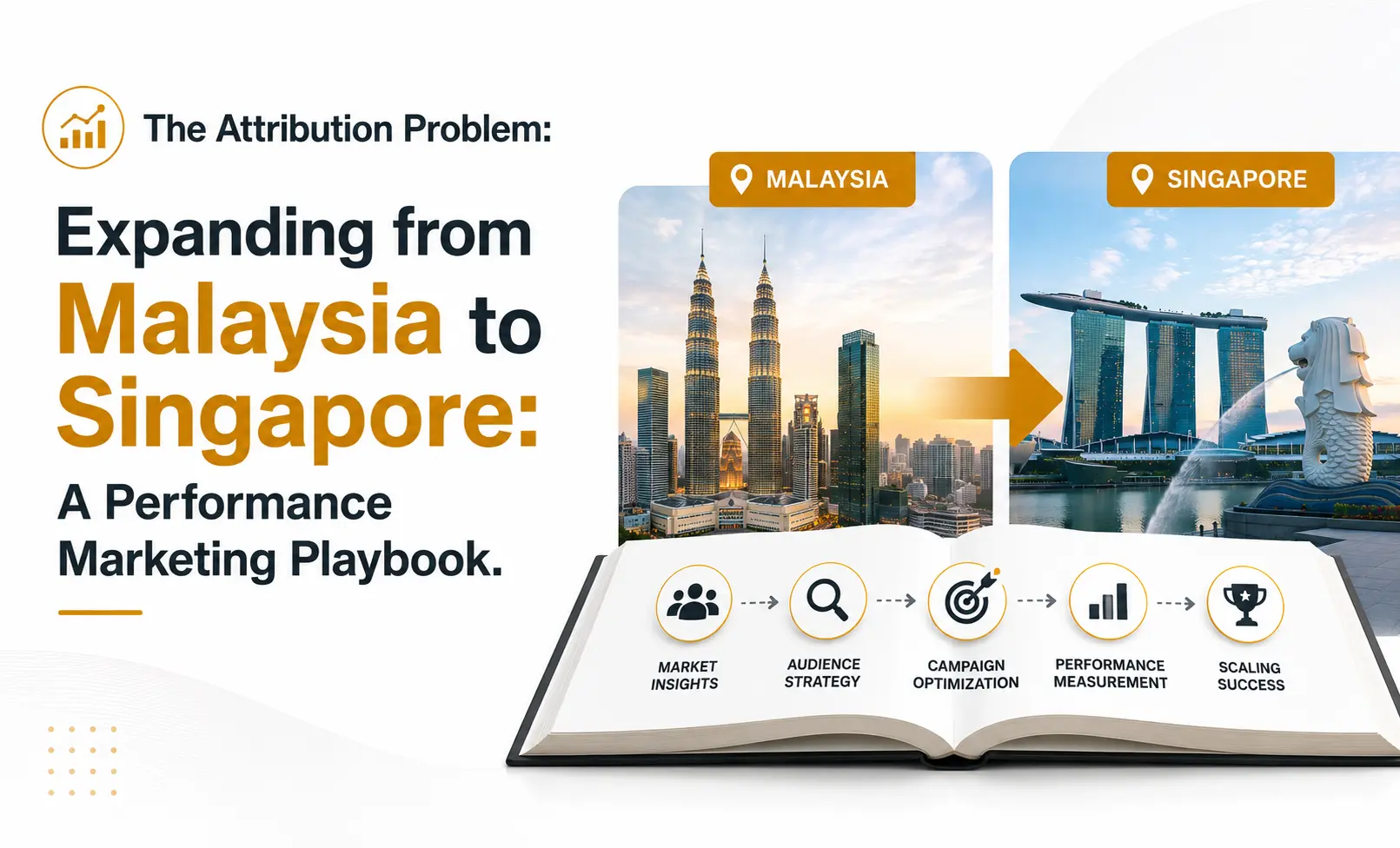
The most effective approach for enterprise Malaysian B2B brands is to treat LinkedIn and Google as complementary, not competing. Google captures demand from prospects already in market; LinkedIn creates demand among prospects who are not yet actively searching. Together, the two channels cover the full funnel. Running LinkedIn in isolation and measuring it purely on lead volume misunderstands what the platform is optimised to do. Our PPC & Paid Media team builds integrated paid strategies that assign each channel to the role it plays best in the funnel.
A Framework for LinkedIn Ads That Actually Works in Malaysia
Given everything above, here is the three-phase framework we use for LinkedIn campaigns in the Malaysian market. It is designed for a B2B brand with a minimum monthly budget of RM 10,000 and a six-month runway — both of which are prerequisites for LinkedIn to deliver meaningful pipeline.
Phase 1 — Month 1: Learn What Resonates. Objective: Brand Awareness or Website Visits. Targeting: deliberately broad — Senior ICs and above in your target function, all of Malaysia, company sizes 50+. Creative: thought leadership content — industry insights, data-led articles, point-of-view pieces. No hard sell. The goal of Phase 1 is not to generate leads — it is to understand which content themes, which audience segments, and which creative formats generate engagement from the people who will eventually convert. Track: video view rate, click-through rate by audience segment, website visitor volume from LinkedIn.
Phase 2 — Month 2: Retarget and Convert. Objective: Lead Generation using Lead Gen Forms. Targeting: retarget everyone who engaged with Phase 1 content — video viewers, page followers, website visitors via LinkedIn Insight Tag. Also introduce Matched Audiences using your CRM warm lead list. Creative: offer-driven content — gated white papers via Document Ads, webinar registration via Conversation Ads, free audit or consultation via Sponsored Content with Lead Gen Form. This is where CPL benchmarks are established. If Phase 1 ran correctly, Phase 2 will convert a warmer audience at a materially lower CPL than cold targeting would produce.
Phase 3 — Month 3 and Beyond: Scale and Introduce ABM. Scale the creative combinations and audience segments that performed in Phase 2. Introduce Account Based Marketing (ABM) targeting — upload a target account list of your highest-priority prospects and run campaigns specifically tailored to those organisations. In Malaysia's enterprise B2B market, a list of 50 to 100 target accounts is often sufficient to drive meaningful pipeline. ABM on LinkedIn allows you to coordinate message across multiple stakeholders within the same organisation simultaneously, which is particularly effective for complex B2B sales with multiple decision-makers.
Throughout all three phases, the metrics that matter are not just campaign-level CPL. Track lead quality score — defined by your sales team's feedback on whether LinkedIn-sourced leads are actually qualified. Track pipeline influenced, not just pipeline generated — LinkedIn often accelerates deals that originated elsewhere. Track content engagement rate as a leading indicator of audience resonance before conversion data is available.
LinkedIn is an expensive, demanding channel that rewards patience and structural rigour. Brands that approach it as a performance channel from day one will consistently underperform. Brands that understand it as a pipeline-building engine that requires three to six months to calibrate will find it one of the most defensible sources of enterprise B2B leads available in the Malaysian market.