Why Attribution Is the Most Misunderstood Problem in Malaysian Marketing
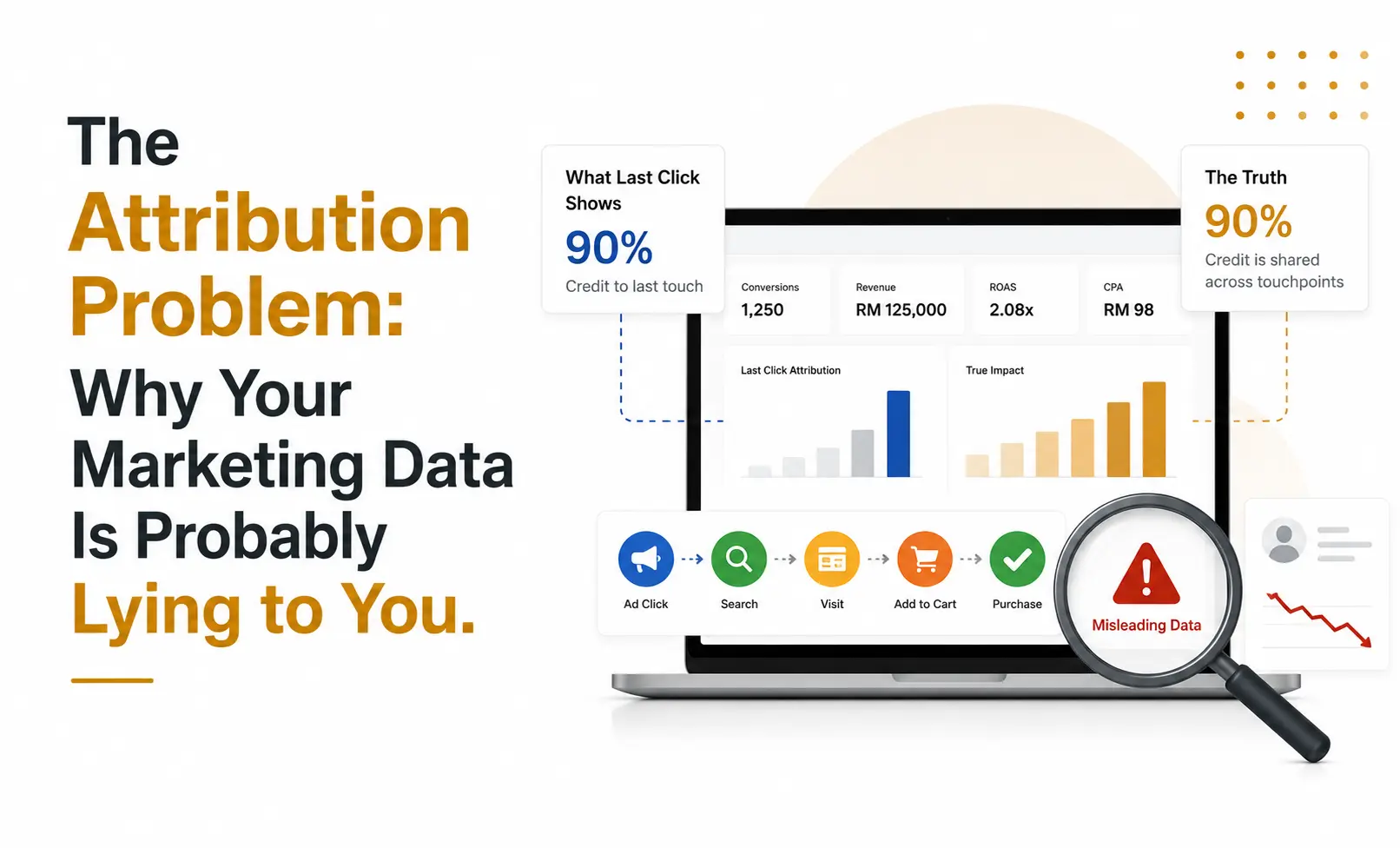
If you ask a Malaysian marketing manager which channel is driving the most leads, the answer will almost always reference the last thing a prospect touched before converting — the final Google search, the last email click, the branded search they ran right before filling in the contact form. This is not because the marketing manager is unsophisticated. It is because this is what GA4 shows by default, and last-click is the easiest model to understand and explain to leadership.
The problem is that last-click attribution describes who closed the deal, not who started the conversation. It ignores the blog post a prospect read three months ago that first made them aware of your brand. It ignores the LinkedIn ad they saw before they knew what to search for. It ignores the comparison guide that moved them from interest to active evaluation. By the time someone types your brand name into Google and clicks through to your contact form, the majority of the marketing work has already been done — by channels that last-click attribution credits with nothing.
This systematic blindspot leads to two predictable and damaging budget decisions. First, brands systematically underfund top-of-funnel channels — SEO, content marketing, organic social, awareness-stage paid media — because these channels appear to produce no conversions in a last-click model. Second, brands systematically overfund branded search, which typically receives enormous credit for conversions it did not actually cause. Branded search captures demand that already exists; it rarely creates it. Cutting branded search spend rarely causes a meaningful decline in conversions, because prospects who are searching for your brand name are already committed — they will find you regardless. But this is almost impossible to see when your attribution model credits branded search with every conversion it touches last.
The Real Cost of Last-Click Attribution in Malaysia
To make this concrete, consider a pattern we observe regularly in Malaysian B2B companies. A technology or professional services brand in Kuala Lumpur has been investing in SEO and content marketing for 18 months. The content is working — it drives significant organic traffic, and a substantial portion of the brand's best leads report first encountering the company through a blog article or a LinkedIn post referencing that content. In the CRM, however, these leads are attributed to "branded search" or "direct" — because by the time they filled in the form, they had already typed the company name into Google.
The marketing dashboard shows SEO contributing very few direct conversions. It shows branded search contributing a large number. The CMO takes the data at face value and makes what seems like a logical decision: reallocate budget from SEO to branded paid search and Google Ads. The reallocation is approved, the content programme is reduced, and for the next two quarters performance appears stable — because the pipeline built during the content investment is still converting. Then, six months later, the top-of-funnel dries up. Discovery traffic drops. Fewer new prospects enter the pipeline. Branded search clicks hold steady, but there are fewer searches to capture, because fewer people discovered the brand organically. The pipeline contraction arrives quietly, with a six-month lag, and by the time it is visible in revenue numbers it is very difficult to trace back to the attribution-driven budget decision that caused it.
This is the attribution trap: when you optimise for your model rather than for reality, the model improves and the business declines.
When your attribution model is wrong, every budget decision based on it is also wrong. Last-click does not just misreport performance — it actively drives resources toward the wrong channels over time.
GA4's Attribution Models Explained
GA4 offers several attribution models, and understanding the differences between them is the prerequisite for any serious attribution conversation. It is worth taking the time to understand what each one actually measures before deciding which to use as your primary reporting view.
Last click attributes 100 percent of conversion credit to the final non-direct touchpoint before conversion. This is the default for many standard reports in GA4 and remains the most widely used model in Malaysia despite its significant limitations. It is simple and easy to explain, which is why it persists — but it produces systematically distorted budget guidance.
Data-driven attribution is now the default model for conversion reporting in GA4, but many brands have not configured their GA4 implementation correctly enough for this to be meaningful. Data-driven uses Google's machine learning to distribute conversion credit across all touchpoints based on their observed contribution to conversions. It analyses thousands of conversion paths and determines, statistically, which touchpoints genuinely move people toward conversion and which are merely present in the path. For brands with sufficient data volume, this is the most accurate model available.
Linear attribution distributes conversion credit equally across all touchpoints in the conversion path. If a prospect touched five different channels before converting, each channel receives 20 percent of the credit. This is more equitable than last-click but can overvalue low-intent touchpoints that happen to appear in many conversion paths without materially influencing behaviour.
Time decay attribution gives more credit to touchpoints that occurred closer to the conversion event, and less credit to earlier touchpoints. This model has some intuitive logic — a touchpoint that occurred one day before conversion is more likely to have been decision-relevant than a touchpoint from six months prior — but it still systematically undervalues awareness-stage activity.
Position-based (U-shaped) attribution gives 40 percent of credit to the first touchpoint, 40 percent to the last touchpoint, and distributes the remaining 20 percent equally across middle touchpoints. This model recognises the importance of both discovery and conversion while acknowledging that the middle of the funnel has some influence — making it a reasonable starting point for B2B brands with longer sales cycles.
For Malaysian brands with sufficient conversion volume, data-driven is the model to use for primary reporting and budget decisions. The catch is that data-driven attribution in GA4 requires meaningful data volume to produce reliable outputs.
For brands that do not meet this threshold, position-based attribution is a pragmatic interim model that provides a more balanced view than last-click while remaining interpretable without a data science team.
Building a Practical Multi-Touch Framework for Malaysian Brands
Moving from last-click attribution to a multi-touch framework is not a single step — it is a five-step process that requires both technical implementation and organisational change. Here is how we approach it for clients.
Step 1: Map your actual customer journey. Before touching any analytics platform, interview your sales team. Ask them where the leads they close typically first heard about the company. Ask what content, events, or interactions they reference during the sales process. Ask which channels produce the leads that convert fastest and have the highest lifetime value. This qualitative data is essential context that no analytics platform can provide on its own, and it gives you a hypothesis to test against your attribution data.
Step 2: Tag every touchpoint properly in GA4. Multi-touch attribution is only as good as your tracking. Every campaign — paid search, paid social, email, organic social — must have consistent UTM parameters. Every key event on your website must be tagged as a GA4 conversion. Your GA4 data streams must be configured correctly and verified regularly. Many Malaysian brands discover during this step that they have significant tracking gaps — entire channels that are not being captured because UTM parameters were not applied consistently, or because GA4 events were set up incorrectly.
Step 3: Use the GA4 Advertising Attribution report to compare models. GA4's Advertising section includes an Attribution report that allows you to view conversion data through multiple attribution lenses simultaneously. Set up a comparison between last-click and data-driven (or position-based if you do not qualify for data-driven) and look at how channel credit shifts between models. The shifts here are usually illuminating — and often surprising.
Step 4: Overlay CRM data for offline conversions. For B2B brands with sales cycles longer than 30 days, web analytics alone will never tell the complete story. Your CRM — whether HubSpot, Salesforce, or another platform — holds the data on which leads actually became opportunities and customers. Connecting GA4 data to CRM data, either through native integrations or through Looker Studio, gives you a view of which channels produce leads that convert, not just leads that fill in forms. In Malaysia's B2B market, where a typical enterprise sales cycle can run three to nine months, this distinction is commercially critical.
Step 5: Build a reporting view that shows multiple models side by side. The goal is not to pick one attribution model and declare it correct. The goal is to understand where the models agree and where they diverge, because the divergences are where the most actionable insights live. A Looker Studio dashboard that shows first-touch, last-touch, and data-driven attribution by channel, with conversion volume and revenue data from your CRM, gives your leadership team the context to make informed budget decisions rather than relying on a single, inevitably incomplete view. Our Analytics & BI team builds this type of cross-model reporting as standard for clients who need to move beyond platform-native reporting.
What Multi-Touch Attribution Reveals About Channel Performance
When Malaysian brands move from last-click to a multi-touch attribution model, the channel performance picture shifts in consistent and predictable ways. Understanding these patterns in advance helps you interpret what you find without being caught off guard.
SEO and content marketing typically receive 2 to 3 times more first-touch credit than last-touch credit. This reflects the reality that organic search is frequently the channel through which prospects first discover a brand, but rarely the final touchpoint before conversion. A prospect who reads a blog post about supply chain optimisation in 2025, then returns directly six months later to request a demo, will show as a direct conversion in last-click — but a first-touch or multi-touch model will credit the organic channel that created initial awareness.
Paid social typically generates 1.5 to 2 times more assisted conversions than direct (last-touch) conversions. LinkedIn Ads, Meta Ads, and other social platforms are largely interruptive by nature — they appear in front of prospects who were not actively searching. They are effective at creating awareness and retargeting, but rarely the final touchpoint before a B2B conversion. Last-click systematically undervalues their contribution, which leads brands to underinvest in the paid social activity that fills the top of their funnel.
Branded search is typically credited 4 to 5 times more than its true contribution in multi-touch models. This is the most dramatic shift, and the one most likely to generate internal debate. When you remove last-click as the default and look at how often branded search appears as the only touchpoint — versus appearing as the final touchpoint after multiple prior interactions — the number shrinks dramatically.
These patterns collectively point to the same conclusion: Malaysian brands are systematically underinvesting in organic and top-of-funnel channels, and systematically overinvesting in branded search and other bottom-of-funnel channels that capture demand rather than create it. Rebalancing toward a more accurate picture of how demand is generated does not mean abandoning bottom-of-funnel spend — it means ensuring that the channels feeding the funnel receive the investment needed to sustain pipeline over the long term.
Three Things Malaysian Marketing Teams Can Do This Month
Attribution is a complex topic, and it is easy to feel paralysed by the scope of what a comprehensive multi-touch framework requires. The most effective approach is to start with three high-value actions that can be completed this month with existing tools.
Enable data-driven attribution in your GA4 conversion settings — if you are eligible. Navigate to Admin > Attribution Settings in GA4 and check whether data-driven attribution is available for your account. If your conversion volume meets the threshold, switch from last-click to data-driven as your primary attribution model. This single change will immediately produce more accurate channel credit distribution in your Advertising reports, with no additional technical work required.
Pull the Model Comparison Report in GA4. Go to Advertising > Attribution > Model Comparison. Select last-click and data-driven (or position-based) as your two models, then apply the report to your top channels and campaigns. Look for channels where the two models produce materially different credit figures — a channel that shows significantly more conversions in data-driven than in last-click is likely being undervalued in your budget decisions. A channel that shows fewer conversions in data-driven may be consuming more budget than its actual contribution warrants.
Export the Top Conversion Paths report. In GA4's Advertising section, the Top Conversion Paths report shows the actual sequence of channel touchpoints that preceded conversions. This report is often more revealing than attribution comparisons because it shows the journey, not just the endpoint. Look for patterns: how many touchpoints precede a typical conversion? Which channels appear most frequently at the beginning of paths versus at the end? How long are typical conversion paths in days? These patterns will tell you more about how your customers actually behave than any single attribution model can.
Beyond these three steps, establishing a monthly attribution review meeting — attended by all channel owners, not just the analytics team — creates the organisational habit of looking at marketing performance through a multi-touch lens. When SEO, paid media, social, and email teams understand how their channels contribute to shared conversion outcomes, budget conversations become more collaborative and more data-driven.
The principle to carry into every budget discussion: do not cut or increase channel spend based on last-click data alone. Always look at assisted conversions, first-touch credit, and conversion path data before making significant reallocation decisions. Our Analytics & BI team helps marketing teams in Malaysia build the reporting infrastructure and analytical discipline to make these conversations routine rather than exceptional.
Tools That Help Malaysian Brands Get Attribution Right
No single tool provides perfect attribution, and the right tool depends on your business model, conversion volume, channel mix, and sales cycle length. Here is an honest assessment of the options available to Malaysian brands at different stages of analytical maturity.
GA4 (free) is the right starting point for most Malaysian brands. When properly configured — with consistent UTM tagging, correctly implemented conversion events, linked Google Ads and Search Console, and the right attribution model selected — GA4 provides a genuinely useful multi-touch view of digital channel performance. Its limitations are the data-driven attribution threshold, the absence of offline conversion data, and the 30-day conversion window that can underrepresent long B2B sales cycles. For most brands managing marketing budgets below RM 500,000 per month, GA4 is sufficient when used thoughtfully.
Looker Studio (free) is the reporting layer that makes GA4 data genuinely actionable for teams. A well-built Looker Studio dashboard can combine GA4 attribution data, Google Ads performance data, and CRM data into a single cross-channel view that leadership can interpret without needing analytics expertise. It does not add new attribution intelligence, but it makes existing attribution data far more accessible and actionable.
Triple Whale and Northbeam are purpose-built for ecommerce brands running multiple paid media platforms — Meta Ads, Google Ads, TikTok Ads, and others simultaneously. They offer pixel-based attribution that is independent of platform-reported numbers, which addresses the fundamental problem of each platform claiming credit for the same conversion. For Malaysian ecommerce brands with significant multi-channel paid media spend, these tools can provide substantial clarity — but they require meaningful ad spend to justify the monthly investment.
HubSpot and Salesforce solve a different part of the attribution problem: offline conversion tracking and revenue attribution for B2B brands with long sales cycles. When a prospect fills in a form in January and closes as a customer in October, web analytics will typically lose the thread of that journey. A properly configured CRM that tracks the full journey from first touch to closed deal — with original source captured at lead creation — provides the only accurate picture of which marketing channels are producing revenue, not just leads. For Malaysian B2B brands in professional services, technology, property, and financial services, CRM-based attribution is often more commercially relevant than any digital analytics model.
The selection principle is straightforward: match your tool to your data volume and your primary conversion type. A high-volume ecommerce brand needs different tools than a low-volume enterprise B2B firm. Both need better attribution than last-click — but the path to getting there looks quite different.
Attribution is not a one-time project. It is an ongoing capability that requires regular maintenance as channels evolve, as your GA4 implementation changes, and as your business model shifts. The brands that get attribution right treat it as infrastructure — not a report to generate once, but a system to maintain continuously.