The Numbers That Explain Why TikTok Can No Longer Be Ignored
The most common objection we hear from enterprise marketing teams when TikTok comes up is some version of: "it's a platform for teenagers doing dance videos." That perception is now two or three years out of date — and the gap between perception and reality is costing brands real acquisition volume.
According to DataReportal, TikTok had 15 million monthly active users in Malaysia as of 2025. That figure alone would make it a channel worth serious attention. What makes it exceptional is the engagement depth behind it. The average Malaysian TikTok user spends 95 minutes per day on the platform — more than they spend on Facebook, Instagram, or YouTube. TikTok has become the second most-used social application in Malaysia after WhatsApp, which means it commands more daily engaged attention than any other content platform in the country.
The commercial signal is equally striking. 73 percent of Malaysian TikTok users have made a purchase after seeing a TikTok video. That is not a brand awareness metric. That is purchase intent translating directly into transaction — the kind of signal that justifies shifting meaningful budget allocation, not just testing a small experimental spend.
For context: Facebook took roughly a decade to build this kind of commercial infrastructure in Southeast Asia. TikTok has done it in four years. Brands that are still classifying TikTok as a brand awareness experiment are not being cautious — they are leaving the channel to competitors who have already worked out how to run it for measurable returns.
The Shift from Awareness to Performance on TikTok
Two years ago, the honest description of TikTok advertising was: you run videos, you hope for brand lift, you have no reliable way to close the loop back to revenue. The platform's ad infrastructure was nascent. The tracking was limited. The commerce layer did not exist. For performance marketers, it was genuinely not ready.
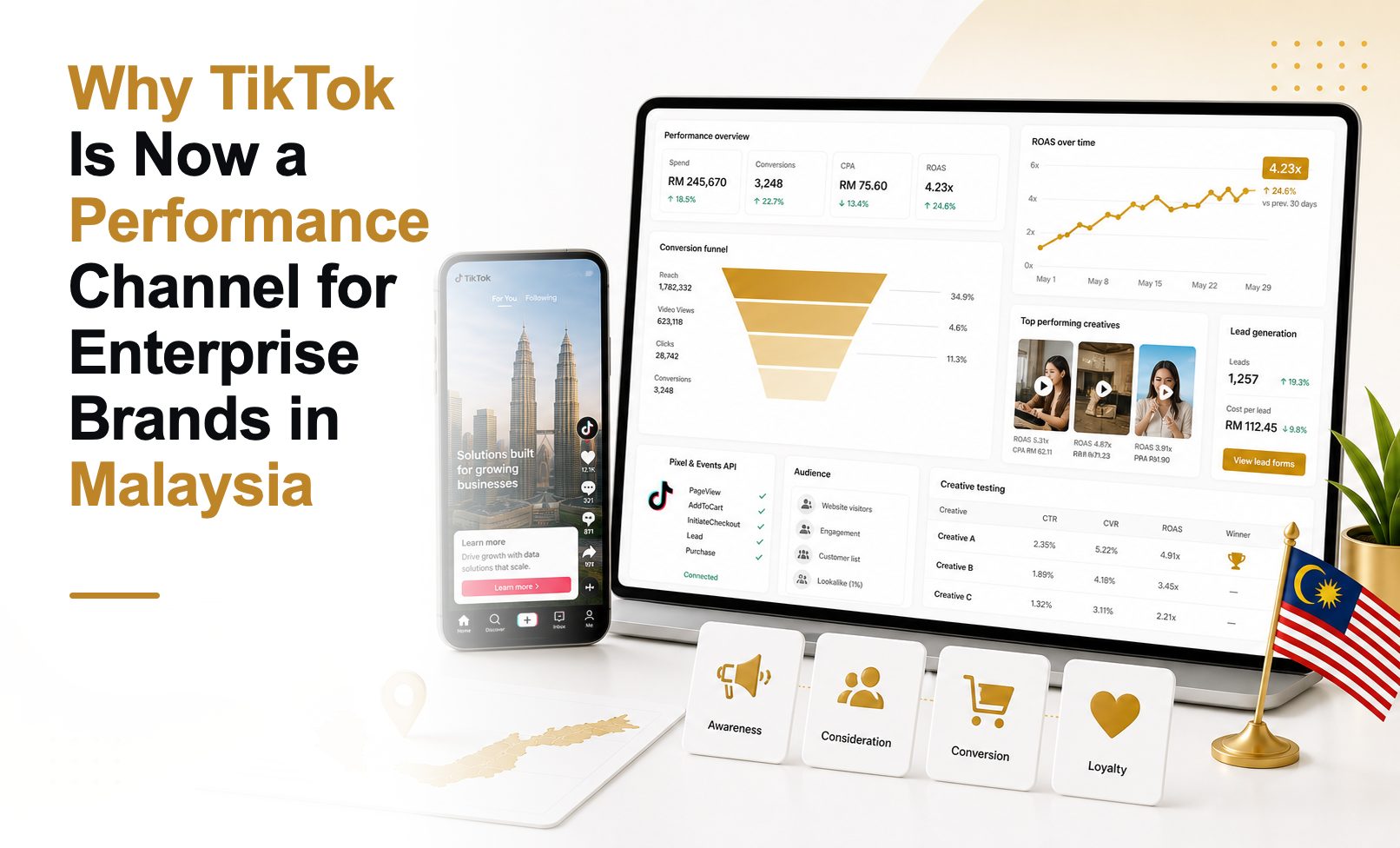
That has changed substantially. TikTok now has a mature Pixel implementation, a server-side Events API for improved measurement in a cookie-limited environment, Smart+ campaigns (the equivalent of Meta's Advantage+ automation), a fully built-out TikTok Shop infrastructure, and lead generation ad formats with native form fills. The platform has built, in the space of two years, the same performance infrastructure that Meta spent 2013 to 2016 constructing.
That comparison to Meta's evolution is not incidental. Brands that were running Facebook purely as a brand awareness channel in 2015 — boosting posts, running reach campaigns, refusing to track conversions because "social doesn't convert directly" — were badly positioned when Meta's performance advertising capabilities matured. The brands that had already started building conversion tracking, testing direct response creative, and learning how to structure campaigns for acquisition were ready to scale when the platform hit its stride. They had the data, the creative learning, and the operational muscle.
The same dynamic is playing out on TikTok right now. The performance infrastructure exists. The user base is massive and engaged. The cost per impression is still substantially lower than comparable Meta placements — because the platform is still in its growth phase in Malaysia and auction competition is relatively thin. The window for early-mover advantage is open, but it will not stay open indefinitely.
Our Social Content team works with enterprise brands across Malaysia and Singapore to build TikTok programmes that are structured from day one for measurable acquisition — not brand awareness campaigns retrofitted to track performance.
Brands that treated Facebook as an awareness channel in 2015 missed the performance wave. The same mistake is being made on TikTok right now — and the cost of missing it will compound as auction competition increases over the next 12 to 18 months.
TikTok Shop: The Commerce Layer Changing Malaysian Retail Marketing
TikTok Shop launched in Malaysia in 2021. By 2025 it had become the third largest ecommerce platform in the country by gross merchandise value — a position that took Lazada and Shopee years longer to reach from their respective launches. The speed of that growth reflects something structurally different about TikTok Shop compared to traditional ecommerce marketplaces: the discovery and purchase loop happen inside the same session, without a friction-inducing redirect to an external site.
Malaysian consumer brands can now sell directly through live streams, through product links embedded in videos, and through a dedicated shop tab on their TikTok profile. A viewer watching a skincare brand's product demonstration can tap the product link, review the listing, and complete a purchase without ever leaving TikTok. The conversion funnel from first exposure to transaction can be measured in minutes, not days. This is the full closure of the awareness-to-purchase loop inside a single platform — something Facebook has aspired to with its Shops product but has not achieved at the same scale in this market.
For Malaysian consumer brands — particularly in FMCG, beauty, fashion, health, and home categories — TikTok Shop represents the biggest channel opportunity since Shopee launched its integrated marketplace model in the region. Brands that have built strong organic presences on the platform and then layered TikTok Shop onto that foundation are seeing conversion rates that outperform their standalone ecommerce properties in several categories.
For B2B brands and service businesses, TikTok Shop is not the relevant opportunity — but TikTok's Lead Generation objective and Website Conversions campaigns are. A B2B software company, a financial services provider, or a professional services firm cannot sell through a shop tab, but they can run highly targeted lead generation campaigns with native TikTok lead forms, collecting qualified prospects without requiring a landing page visit. The targeting and conversion infrastructure works for these use cases just as effectively as it does for consumer commerce.
Campaign Structure for Performance-First TikTok
The single most common mistake we see in TikTok Ads accounts that are underperforming is objective misalignment. Brands run Reach or Video Views campaigns and then wonder why they are not generating leads or purchases. The objective you select in TikTok Ads Manager determines which users the algorithm targets and how it bids — choose the wrong one and you will reach a lot of people who were never going to convert.
For performance-focused campaigns, the objective should be Website Conversions for ecommerce and traffic-to-site goals, or Lead Generation for B2B and service businesses collecting contact details. These objectives signal to TikTok's algorithm that you want people who are likely to take action, not people who are likely to watch a video for 30 seconds.
On audience strategy: TikTok's recommendation, and our experience running accounts in this market, is to start broader than you think you should. Set your geographic targeting to Malaysia, your age range to 18-45, and add one to two loosely related interest categories. Resist the temptation to layer on demographic restrictions, income segments, and behavioural filters from day one. TikTok's algorithm is genuinely better at finding buyers than manual targeting — it has first-party behavioural data that third-party demographic segments cannot replicate. Tighten the audience only after you have enough conversion data to see where your actual customers are concentrated.
Creative is where TikTok campaigns are won or lost. You need a minimum of three to five video variations at launch — not one polished hero video, but multiple creative angles testing different hooks, different value propositions, and different formats. TikTok creative fatigue is real and fast: a video that performs well in week one will often be exhausted by week three as the algorithm shows it to the same pool of users. Plan for weekly creative rotation from the start, not as a reactive measure when performance drops.
Once your campaign has accumulated 50 or more conversion events, Smart+ campaigns — TikTok's equivalent of Meta's Advantage+ — are worth testing. Smart+ optimises simultaneously across audience, placement, and creative combinations, and it can meaningfully outperform manually structured campaigns once the algorithm has sufficient signal quality to work with. Below that conversion threshold, manual campaign structures give you more control over the learning process.
The non-negotiable operational foundation is TikTok Pixel plus Events API. Install the Pixel through TikTok Business Manager (Assets → Events), implement the Events API for server-side tracking, and configure the right events for your business model. For ecommerce: ViewContent, AddToCart, InitiateCheckout, and Purchase. For B2B and lead gen: PageView, ViewContent, and Lead (or CompleteRegistration). Without accurate event data flowing into TikTok Ads Manager, you are asking the algorithm to optimise without feedback — and your paid media investment will underperform as a result.
Creative Formats That Drive Performance in Malaysia
TikTok offers several distinct ad formats, and the right choice depends on your campaign objective and budget level. Here is how each maps to practical use cases in the Malaysian market.
In-feed ads are the workhorse format for performance campaigns. They appear between pieces of organic content in the For You feed, are skippable after a few seconds, and behave like organic posts — users can like, comment, and share. For most brands running direct response campaigns, in-feed ads are where the majority of budget should sit. They are scalable, testable, and the format the algorithm is best optimised to deliver efficiently.
Spark Ads are a format worth prioritising in the Malaysian market specifically. Spark Ads allow you to promote existing organic posts — either from your own account or, with permission, from a creator's account — as paid placements. Because the post already exists with organic engagement, it carries social proof that native ads lack. Malaysian audiences respond particularly well to authentic, unpolished content: a creator demonstrating your product in a genuine, conversational way routinely outperforms a high-production commercial in this market. When you find a piece of organic content that performs above average, boosting it as a Spark Ad is typically a higher-ROI move than creating a new produced asset.
Top View ads are full-screen placements that appear when a user opens the app. They command extremely high CPMs — significantly higher than in-feed — but deliver an impact that other formats cannot replicate for brand launches, product announcements, and tentpole campaign moments. Use them selectively for maximum-visibility moments, not as a performance channel where you need efficient cost per conversion.
Live Shopping Ads drive traffic directly into active TikTok Shop livestreams. For Malaysian brands in FMCG, fashion, beauty, and consumer electronics, livestream commerce is a channel that deserves serious budget allocation. Malaysian consumers have demonstrated a high comfort level with live commerce — the format's real-time demonstration and social proof dynamic drives purchase decisions that static product listings do not.
Across all formats, the creative principle that holds most consistently for Malaysian audiences is edutainment: content that teaches something useful or interesting while also demonstrating your product's value. Pure promotional content — the TikTok equivalent of a TV commercial — tends to be scrolled past. Content that genuinely helps the viewer understand something, solve a problem, or see a product working in a real context holds attention and drives action at meaningfully higher rates.
Budget Allocation and What to Expect in Malaysia
One of the most practical questions enterprise marketing teams ask about TikTok is: what does it actually cost, and what should we expect in return? The honest answer requires separating the testing phase from the optimisation phase — the numbers look different at each stage.
For an initial test to generate statistically meaningful performance data, the minimum viable monthly budget is RM 3,000 to RM 5,000. Below that threshold, the TikTok algorithm does not receive enough events to exit the learning phase and optimise effectively. You will spend money without generating actionable insight. At RM 5,000 per month — roughly RM 165 per day — you have enough daily budget to run two to three ad groups simultaneously and accumulate conversion data fast enough to make meaningful creative and audience decisions within 30 days.
On cost benchmarks: TikTok in-feed CPM in Malaysia currently ranges from RM 8 to RM 18, depending on audience specificity, campaign objective, and creative quality. That is below comparable Facebook in-feed placements, which typically run RM 15 to RM 30 CPM for similar audiences. The lower CPM reflects TikTok's growth phase in the local market — auction competition is still relatively low compared to Meta's mature, densely contested inventory. Average CPC falls between RM 0.50 and RM 2.00, again depending heavily on creative quality: a strong hook that captures attention in the first three seconds significantly reduces your effective CPC by improving quality scores.
For B2B lead generation campaigns, expected cost per lead in Malaysia runs RM 80 to RM 200 — substantially cheaper than LinkedIn, where Malaysian B2B CPLs frequently exceed RM 300 to RM 500 for equivalent seniority and function targeting. TikTok's B2B audience is smaller than LinkedIn's by definition, but for brands whose buyers are active on the platform — technology, financial services, property, F&B — the CPL efficiency is compelling.
For ecommerce, realistic ROAS expectations in the first 90 days sit at 2x to 4x, scaling to 4x to 8x for accounts that have optimised creative, audience, and bidding through sufficient conversion volume. Those ranges are wide because creative quality is the dominant variable — the same budget producing half-hearted video content will see 1.5x ROAS while a brand with strong creative and disciplined testing can hit 5x in the same period.
One critical measurement note: do not evaluate TikTok performance using last-click attribution alone. TikTok is a discovery platform — users see your ad, become aware of your brand, and then convert days later through a Google search or a direct visit. Last-click models will systematically under-credit TikTok's contribution. Use a view-through attribution window of at least one day, and compare performance against a data-driven attribution model in GA4 for a more accurate read of TikTok's role in the conversion path.
Getting Started with TikTok as a Performance Channel
The most effective way to avoid the common pitfalls is to build the operational foundation correctly from day one. Here is the sequence we recommend for enterprise brands launching TikTok as a performance channel.
Step 1: Install TikTok Pixel on your website. Go to TikTok Business Manager, navigate to Assets → Events, and follow the pixel setup process. If your site runs on Shopify or a major CMS, use the native TikTok integration rather than manual implementation — it is faster and less error-prone. Verify the pixel is firing correctly using the TikTok Pixel Helper browser extension before you spend a single ringgit.
Step 2: Set up your TikTok Business Manager and ad account. Create a Business Manager at business.tiktok.com, add your ad account, and link your TikTok Business account (your brand's organic profile). Linking the organic account is what enables Spark Ads later. Apply for TikTok Shop access if you are a consumer brand with ecommerce inventory.
Step 3: Produce three to five short-form video variations. Aim for 15 to 30 seconds. Film on a smartphone — TikTok audiences distrust over-produced content, and vertical mobile video outperforms studio-quality horizontal video on this platform. Write a specific hook for each video: the first three seconds determine whether someone scrolls past or keeps watching, so start with the problem, the result, or the most interesting moment — never a logo and a brand name. Test different angles: one video focused on the problem your product solves, one showing the product in use, one featuring a customer reaction or testimonial.
Step 4: Launch a Conversions campaign with broad targeting. Set your daily budget at RM 50 to RM 100, choose your primary conversion event (Purchase or Lead), and resist the urge to over-target. Malaysia, 18-45, one interest category loosely related to your product — that is enough to start. The algorithm will find your buyers more effectively than manual targeting will at this stage.
Step 5: Run for 7 to 14 days before making any judgements. TikTok's learning phase requires time and conversion volume to stabilise. If you pause, restart, or make structural changes to a campaign in the first seven days, you reset the learning phase and waste the data you have already accumulated. Resist the urge to optimise immediately — watch, but do not touch during the learning phase.
Step 6: Review, cull, and iterate on a weekly cadence. After the learning phase, identify which creative is performing weakest — lowest hook rate (percentage of people who watch past three seconds), highest CPL or cost per purchase — and pause it. Introduce one to two new creative variants to replace what you pulled. Scale daily budget on the best-performing ad group by 20 percent every three to five days rather than doubling it overnight, which destabilises the algorithm's bidding model. This weekly creative cycle is the discipline that separates brands that scale on TikTok from those that test, see mediocre results, and conclude the platform doesn't work.
If you want support structuring a TikTok programme that is built for measurable performance from the start — including creative strategy, pixel implementation, and campaign architecture — our Social Content team runs TikTok as a performance channel for enterprise brands across Malaysia and Singapore. The entry point is a strategy session where we assess your current creative assets, audience, and conversion infrastructure and map out exactly what a properly structured programme looks like for your specific business model.